
What is the process for an institution to become accredited?
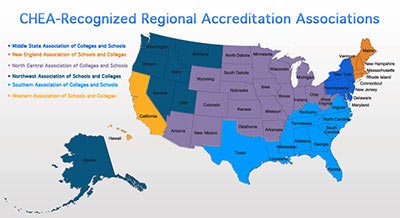
The process for an institution to become accredited varies a bit depending on to which accreditor the school has applied for recognition. Generally, however, the process is along the following lines.
- The institution must have been in operation for at least two years even to begin the accreditation process. There are no institutional accreditors recognized by the U.S. Department of Education or the Council for Higher Education Accreditation that do not have this requirement. The idea is that in order to become accredited, the institution must have at least something of a track record. A related requirement is that institutions must have graduated at least one class with the credentials that they wish to have recognized. In other words, a school that awards Associate, Bachelor, and Master degrees would have to have graduates of all three in order to apply for institutional accreditation. This sometimes means that the institution must have been in operation longer than two years to be eligible to start the process.
- Once the leaders of an institution believe it is ready to begin the accreditation process, they perform what is called a “self study”. This phase is guided by instructions from the accrediting body, and includes a great deal of analysis of the institution's programs and courses, faculty and staff, facilities and resources, and other aspects. This phase can take up to a year to complete.
- After the self study has been submitted to the accrediting body, generally the response will be to award the institution with what is called “candidacy”. This does not mean that the institution is accredited, but only that the accrediting body believes there is evidence that its standards may be sufficient that accreditation can be awarded in the future.
- During candidacy, the institution continues to analyze its processes and standards, submitting reports to the accrediting body.
- The accrediting body will schedule a site visit. In this phase, the candidate school receives visitors sent by the accrediting body who will look into the school firsthand. Accreditation in the U.S. Is a process of peer review, which means that the experts sent to visit the candidate school will be faculty members and administrators from other schools that have already been accredited by that body. In the case of for-profit schools seeking accreditation, accreditors take care not to send employees of direct competitors to review the candidate school's business processes.
- Depending on how well the site visit goes, the reviewers may recommend to the accreditation commission that the school be granted accreditation, that it be continued in candidate status and work out some aspects that are not considered up to standards, or that its candidacy be terminated.
- If the school is awarded accreditation, then the period of accreditation may vary from three to ten years until the next review is scheduled. The schools is expected to maintain high standards throughout that period of time.
There are also various fees payable to the accrediting body by the applicant school at each stage of this process.
Does the accreditation process differ for national and regional accreditation agencies?
The accreditation process does not vary significantly among the six regional accreditors. The same principles of self study and peer review also apply both to the regional and national accrediting bodies.
One exception is that the Distance Education and Training Council (DETC) has a slightly different approach to applicants. DETC does not have a period of candidacy. All schools that have applied are simply applicants until and unless accreditation is awarded. They do, however, have a readiness evaluation that applicant schools either pass or fail, and those that pass are in a position somewhat analogous to candidacy at other accrediting bodies.
How many months does the accreditation process typically last?
The amount of time it takes to go through the entire accreditation process can vary considerably. It is very rare for a school to complete the process in less than one year. In exceptional circumstances, such as institutions that have been in operation for a long time, are well funded, and have well regarded faculty members and a strong research profile, schools have been known to skip over the candidacy period altogether. However, this is extremely rare, and usually the accreditation process can take several years to complete.
What happens when an institution is not granted accreditation? Can they apply elsewhere?
There is no rule that states that an institution that is denied accreditation by one organization cannot seek it from another. More often, institutions that believe they are in danger of losing accreditation from one organization have sought it from another, although usually this is a sign of financial instability on the part of the school and since all accreditors place considerable weight on the financial health of the schools they accredit, this strategy is usually unsuccessful.
Does initial accreditation differ from renewal? How so?
Initial accreditation and renewal are different but related processes. Like initial accreditation, renewal requires a site visit from reviewers appointed by the accrediting body, and those reviewers will come from other schools that are accredited by that same accreditor. The process differs, however, in that schools are expected to have simply maintained and improved standards, such as through Quality Enhancement Plans and other initiatives.
Sometimes an institution will be on probation with an accreditation agency. How does that happen, and typically what steps must the institution take to correct the issues?
A school can be places on probation for many reasons. It may have demonstrated that it is not adhering to the standards set by the accrediting agency. It may have broken its own rules when it comes to its own institutional process. Or, most often, it may have run into financial trouble.
Typically, when an accredited institution has run into trouble, it is first given a warning, which includes the specific corrections it must make. If it cannot or does not fix what has gone wrong, the next step is to be places on probation, again with a list of what must be corrected. Probation is a serious sanction, but it is important to note that institutions that are on probation from their accreditors are still accredited. If the problems continue, then eventually the accrediting body will issue a “show cause” order, demanding that the institution demonstrate immediately why it should not be disaccredited. Absent a compelling response from the school, its accreditation status will then end, and be terminated, and the institution will become unaccredited.
Once an institution has become accredited, it is rare for it to lose this status. Community colleges and public universities in particular almost never lose their accreditation status, but even private institutions only lose this status very infrequently. Normally an institution will do whatever is required to maintain their accreditation. The most common reason for an institution to become disaccredited is that it cannot maintain sufficient financial health to continue operating, and accrediting bodies will take this very seriously because it affects the ability for the school to deliver on the promises that it makes to new and continuing students.
What is candidacy? How does it compare to accreditation?
As mentioned, candidacy is a status offered by some accreditors to applicants who have demonstrated that they are capable of meeting the standards required for accreditation. It does not mean that the institution is accredited, and is not a “pre-accreditation” status. It simply means that the applicant has shown sufficient promise to be worthy to continue on in the accreditation process. Schools that hold candidacy status should therefore still be considered unaccredited.
RELATED ARTICLES
Degrees from Accredited Universities