
 Call them what you want — lawyers, attorneys, sharks — but lawyers are highly qualified professionals who work as advocates and advisors to people, companies, and organizations that need representation in courts of law.
We know you're curious as to whether you can earn a law degree online and what it would be like, so we wrote this quick, easy-to-read "Mini-Guide" to Online Law Degrees to give you the facts you need to decide whether to pursue your law degree online.
What do lawers do exactly?
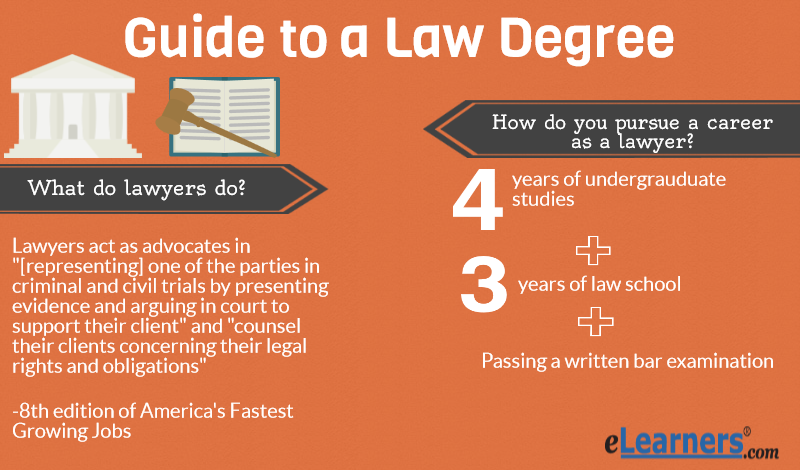
According to the 8th edition of America's Fastest Growing Jobs, lawyers act as advocates in "[representing] one of the parties in criminal and civil trials by presenting evidence and arguing in court to support their client." When acting in the capacity of an advisor, "lawyers counsel their clients concerning their legal rights and obligiations and suggest particular courses of action in business and personal matters."
How do you become a lawyer?
It usually takes a four-year undergraduate degree, three years of law school, and passing a written bar examination to become a lawyer.
Can I really earn a law degree online?
Yes. (If you are patient and very tenacious.) You can earn a juris doctorate (JD) via online education.
However, there are no online law schools that are approved by the American Bar Association. In order to sit for the Bar Exam, in almost any state, you must have graduated from a law school approved by the American Bar Association. California is the one exception; that state has a provision for distance education/ correspondence schools.
It is possible to earn an online law degree from an accredited school, apply to sit for the California Bar Exam, pass the exam, and practice law in California.
What are some other options?
If you don't want to live and practice law in California, you have options:
- Work and wait. Most other states will permit California attorneys to sit for their Bar Exam after at least 5 years of continuous service as a practicing lawyer.
- Appeal. Apply to the admitting authority of the state in which you hope to practice law for approval to sit for the Bar Exam. Build a good case. Ask a representative from your online law school to accompany you to the meeting; or ask the career services center to prepare a written presentation detailing the school's accreditation, curriculum, faculty, and California Bar Exam passage rates.
- Enroll in an apprenticeship program. Washington and Colorado, for instance, are two states that allow an alternative path to becoming an attorney. You can work with a state-licensed attorney for a number of years designated by the state as an apprentice. Enrollment in an online law school is not required. However, the intense study could help you demonstrate mastery of a subject so that you could challenge a module of the apprenticeship program and possibly graduate ahead of schedule.
- Plan to attend more school. Pursue a Masters of Law (LL.M), a program which usually takes between one and two years to complete.
- Go to court. Pass the California Bar Exam and practice law in a federal court in another state.
What else can I do with an online law degree?
Many students who decide to earn a degree from an online law school do not intend to practice law as an attorney. They seek to expand their skill set to grow within their established careers. If you do seek a career change, a law degree can be useful in fields as diverse as healthcare administration, human resources, and compliance. Some areas of law just require that you pass any Bar, not necessarily the Bar Exam from the specific state in which you practice. You can pass the California Bar Exam and work in a corporate environment as in house counsel, or you can opt to practice in a specialty area such as patent law.
How do online law degree programs work?
The online law degree is a four-year program. As in a traditional law school there are courses that all students are required to take. However, the array of courses offered as electives may vary from school to school. The majority of online courses are asynchronous — instructors post a syllabus, lectures, and assignments; students then complete the reading and post questions and comments to discussion boards when it is convenient for them.
In online law schools there is likely to be a synchronous portion of the program as well. Classes "meet" regularly in real-time. With the aid of technology, the Socratic method is alive and well. Professors and students discuss legal cases and decisions. Professors can even "call on" students. Students respond via text and have their answers read by all the others in the class. Unlike conventional law school courses where students may study for 15 weeks and then take one final exam, there can be several opportunities to earn grades. Quizzes and midterm exams, administered online or proctored, may be offered throughout the term. Research papers are e-mailed to the instructor or uploaded to the class site; comments are returned electronically.
Can I start at any time?
Some online law schools maintain open enrollment throughout the year. Applications for admission are reviewed weekly and those accepted into the program are notified immediately. Once you submit the enrollment materials and pay the tuition, you may begin study shortly thereafter.
At William Howard Taft University, for instance, there is a rolling admissions policy that means students may begin to take required courses virtually anytime during the year.
Other online law schools, modeled after fixed structure law schools, are more controlled. They may only admit new students once, twice or three times during the year.
Will I be able to study at my own pace?
Accredited online law school degree programs are designed to meet the requirements of the Committee of Bar Examiners to qualify students to sit for the California Bar Exam.
The program must consist of four academic years. With respect to this subject, an academic year is a period of time not less than 48, but not more than 52 consecutive weeks.
What is the "Baby Bar?"
At the end of the first academic year students are required to pass the First Year Law Students' Examination, also referred to as the "Baby Bar." It covers first year subjects like torts, criminal law, and contracts. The examination, administered by the Committee of Bar Examiners, is given each year in June and October at testing sites in both Northern California and Southern California.
How do I select a good online law degree program?
Research online law schools very carefully. Look for accreditations and credentials that indicate the level of quality of the program. Plan to inquire about the number of full-time faculty, their credentials and experience, the courses offered in comparison to those at a traditional law school, the percentage of students who graduate and sit for the Bar Exam, the percentage who pass the Bar Exam, and student evaluations of the program.
What are the benefits of studying law online?
Enrolling in an online law school allows for far greater flexibility and convenience than in a traditional program at a fixed facility; e-learners do not have to put their lives on hold for several years. The American Bar Association sets restrictions on how much a student can work while in law school. Students are discouraged from working at all during their first year. Online students, however, can keep their jobs and maintain their ability to make a living. They don't have to take out hundreds of thousands of dollars in student loans to pay tuition and cover living expenses. They don't have to sell their houses or move their families to be near a university.
Tuition at a conventional law school at the out-of-state rate often runs for more than $20,000 per year. That does not cover textbooks, materials, rent, or living expenses.
In contrast, the majority of online law schools have set tuition at well under $10,000 per year.
"It's robust," Dean Barry Currier, of Concord Law School, says of the online learning environment. The former law school professor who taught at the University of Florida for 19 years, and who was dean of Cumberland School of Law School in Alabama, and deputy consultant to the ABA Section on Legal Education, is very enthusiastic about online learning. "It's more engaging, effective, and efficient."