

Associate Degree vs Bachelor Degree
If you’re thinking about earning an degree, and are not sure the difference between an associate degree vs bachelor degree you may be wondering which is 'better' or which is enough to pursue your ideal career. The basic differences between an associates degree and a bachelors degree are simple.
7 Differences Between Bachelors and Associates Degree
| Associates Degree | Bachelors Degree | ||
|---|---|---|---|
| 1 | Higher Degree | X | |
| 2 | How Long Will it Take? | Two Years Full Time | Four Years Full Time |
| 3 | Occupational Degree* | Yes | Not Typically |
| 4 | Can be Taken to Prepare for Another Degree | Yes, Bachelors | Yes, Masters |
| 5 | 2014-15 Average Yearly Cost[a] | $10,153 | $25,409 |
| 6 | 2016 Median Salary for Degree Holders[b] | $42,588 | $60,112 |
| 7 | 2016 Unemployment Rate[b] | 3.6% | 2.7% |
*An occupational degree typically does not focus on a broad education. Instead they might focus on teaching job-related skills intended for a specific career such as a dental hygienist, medical assistant, paralegal or other such positions. Explained further below.
Some colleges and universities offer an associates to bachelors degree program, where you earn both degrees. Choosing an associate degree vs bachelor degree is an important first step in your academic pursuit.
Bachelor Degree or Associates Degree, What Comes First?
Now that we have covered the differences, let's discuss what an associates degree is. An associate’s degree is typically granted after a 2 year college program, usually by a community college or junior college. An associate's degree will come before a bachelor's degree. It can act as a stand-alone degree or serve as a stepping stone to the next level of your college education; a bachelor’s degree, which is typically the degree you get after four years of college. If you decide after earning your associate’s degree that you’d like to continue your education, you can typically transfer many of the credits you earned during the two-year program to a bachelor’s degree program.
Associate Degree vs Bachelor Degree : Which Degree Should I Choose?
So how do you decide whether you want to earn an associate’s degree only, or earn your associate’s degree and then transfer those credits to a bachelor’s degree program? You may be wondering whether just two years in college (as opposed to four in a bachelors degree program) are enough to pursue your ideal career. There are several reasons why you may want to earn a two-year online associate degree program. From there you can then decide on choosing an associate degree vs bachelor degree and if you wish to pause your university education or continue on to a bachelor’s degree program.
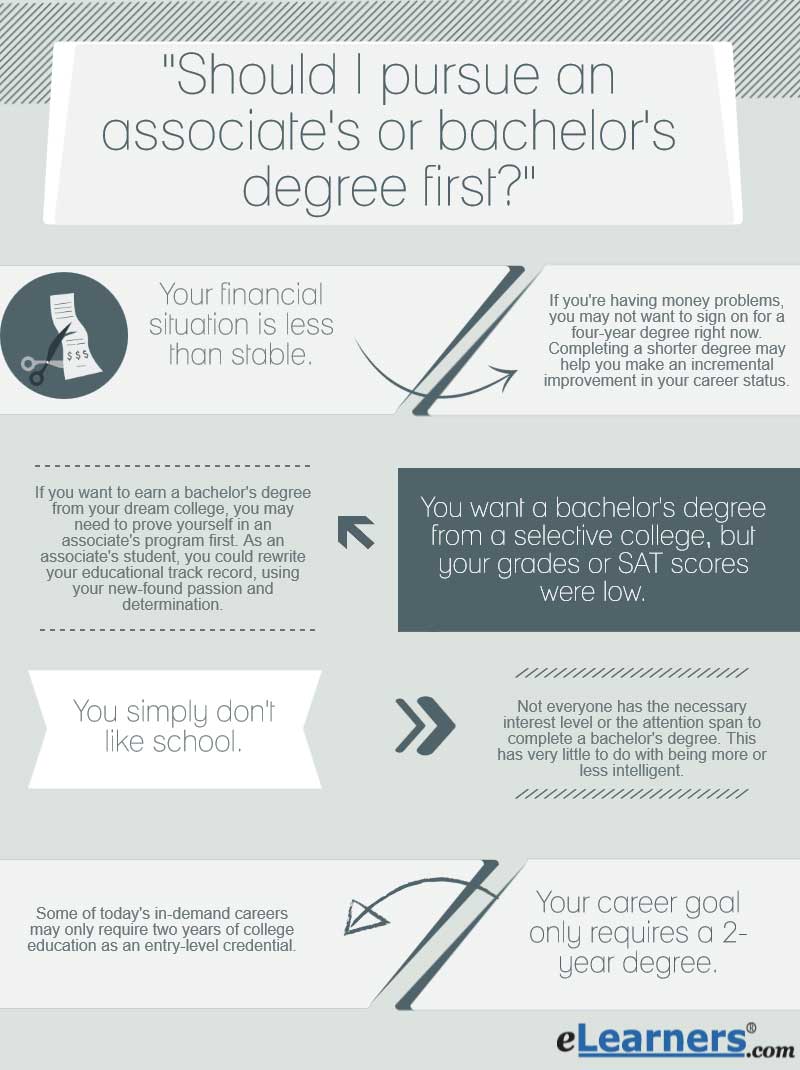
5 Reasons to Earn an Associates Degree
You Are Still Unsure What You Want to Study
Maybe you haven’t determined which career you want to pursue and are still weighing your options. If you look for two-year programs with a focus on general education, you could sample the coursework in various liberal arts subjects, including philosophy, psychology, writing, art, history, computer science, and more. Many associate’s degree programs can also put you in touch with instructors and advisors who can help you identify your strengths and talents. Finally, you may have more flexibility to transition into a specific major or technical program after starting with a shorter program.
Your Financial Situation is Less Than Stable
If you're having money problems, you may not want to sign on for a four-year degree right now. When choosing a bachelor degree or associates degree you may decide that completing a shorter degree (perhaps at a community college, where tuition rates are typically much lower than those at four-year schools) may help you expand your opportunities in the job you have now, even if you plan to pursue a different career later in life. You don't have to forget about your long-term career goals – just consider taking a break between these stages of your studies to work towards a more solid financial footing before going back to school to finish your bachelor’s degree. Keeping an eye on your finances is very important when deciding on an associate degree vs bachelor degree.
You Want a Bachelors Degree From a Selective College, But Your High School Grades or SAT Scores Were Low
You likely can't get accepted into a top-notch college if your high school grades were mostly D's. And these days, even state schools are quite competitive. If you want to earn a bachelor's degree from a name brand college or your state’s well-known university, you may need to prove yourself in an associates program first. As an associate's student, you could use your newfound passion and determination to rewrite your educational track record. Schools may look more favorably on the improved grades you earned during your associate’s degree program and be more willing to overlook poor performance during high school.
Some Careers May Only Expect an Associate Degree vs Bachelor Degree
Many of today's in-demand careers only require two years of college education as an entry-level credential, which would suggest an associate degree should be you rpick when considering associate vs bachelor. The following list represents just a few of them[i]:
Job Title
Entry-Level Education Requirement
2016 Median Pay
Paralegals and Legal Assistants[i]
Associate's Degree
$49,500
Registered Nurses[ii]
Associate's Degree
$68,450
Computer Network Support Specialists[iii]
Associate's Degree
$52,160
Radiologic Technologists[iv]
Associate's Degree
$58,960
Dental Hygienists[v]
Associate's Degree
$72,910
Web Developer[vi]
Associate's Degree
$66,130
Physical Therapy Assistant[vii]
Associate's Degree
$45,290
You Don’t Want to Devote Too Many Years to Schooling
Not everyone has the necessary interest level or the attention span to complete a bachelors degree, which is an important thing to consider when deciding on an associate degree vs bachelor degree. This has very little to do with being more or less intelligent. Research shows that human beings are more likely to enjoy tasks that they are naturally good at. For example, athletic people enjoy playing sports. Mechanical people enjoy tinkering with engines. Verbal people enjoy reading and writing, which happen to be two skills that are frequently utilized in a bachelor's degree program.
If you're not naturally a verbal person, you can still learn how to read and write, but you probably won't want to spend three or four years — beyond high school — doing these exercises at an advanced level. For you, a bachelor's degree may not be the best option. Instead, you should try to determine your natural strengths and which of those would lend well to an associate’s degree program. Maybe you have excellent fine-motor skills, which could help you become a talented electrician or mechanic. An associate's degree can help prepare you with the knowledge you need to pursue your ideal career, and you could start doing what you love that much sooner.
Online Associate's Degree: Professional Insight
"Earning an Associate’s Degree gave me the education to start and operate my own food business which has led to remarkable success. My first company was acquired in 2015 which boasted an annual gross revenue of one million dollars. Today, I am developing a new line of natural food products which will be available nationally in July 2017.”
.png)
-Veronica Rains Daily, Entrepreneur & Business Owner
Is Getting an Associates Degree Worth it? Associates vs. Bachelors Comparison
Is there a big payoff in obtaining either an associates degree or bachelors degree? Of course this answer may vary wildly if comparing specific fields, but in general terms, if we look at the earnings of an associates degree holder over a 40 year work life[b] and subtract the cost of an education[a] and compare that to those that do not earn a degree or to those who earn a bachelors degree, you can get a pretty good idea of which path may be more palatable for you. After all, earnings and cost are only two factors in the decision process when thinking about an associate degree vs bachelor degree.
| 2016 Median 40 Year Work Earnings[b] | 2016 Median 40 Year High School Grad Earnings | 2014-2015 Average College Costs[a] | Foregone Earnings (during college years) | Net Payoff | |
|---|---|---|---|---|---|
| Associates Degree Earner | $1,703,520 | $1,439,360 | $20,306 | $71,968 | $171,886 |
| Bachelors Degree Earner | $2,404,480 | $1,439,360 | $101,636 | $143,936 | $719,988 |
40 year calculations were derived by multiplying the median annual wage by 40 years. It is important to note that these estimates are not exact because they assume that $1 in future earnings has the same value as $1 earned today, i.e., the future earnings were not discounted. Over a 40-year horizon, discounting can make difference. Average college costs and foregone earnings also assume that the degree earner earns their degree in a 2 or 5 year span respectively which implies attending college full time.
5 Reasons to Pursue a Bachelors Degree
1. Many Jobs Require a Bachelors Degree
According the United States Bureau of Labor Statistics (BLS), 18% of jobs nationwide require that candidates have a bachelors degree. In 2013, these positions had a combined median annual salary of $68,190. Positions in fields such as finance and industry, science, and technical services typically have high concentrations of jobs that require a bachelors degree.[viii]
Some of the specific jobs that require a bachelors degree include:
Job Title | Entry-Level Education | 2016 Median Annual Salary |
Petroleum Engineers[ix] | Bachelors Degree | $128,230 |
Aerospace Engineers[x] | Bachelors Degree | $109,650 |
Occupational Health and Safety Specialists[xi] | Bachelors Degree | $70,920 |
Human Resources Managers[xii] | Bachelors Degree | $106,910 |
Architects[xiii] | Bachelors Degree | $76,930 |
Sales Managers[xiv] | Bachelors Degree | $117,960 |
Kindergarten and Elementary School Teachers[xv] | Bachelors Degree | $55,490 |
2. You Know What you Want to Study
While earning a bachelors degree may be a good option for students who aren’t sure what field they want to study, it can be especially beneficial to those who already know what degree they want to pursue. If you know what degree you’re interested in, you can research specific schools and programs, as well as compare specific courses of study to find a perfect match for you.
3. You Want to Pursue a Graduate Degree
Many graduate degree programs, such as a masters, doctorates, or post-baccalaureate certificates, require that candidates have earned at least a bachelors degree. Therefore, knowing that you may want to pursue a graduate degree means that you should earn a bachelors degree.
4. There Are a Number of Different Degree Options
Choosing to earn a bachelors degree provides you with a number of different types of degrees that you can pursue. While you may be able to earn an associates degree in many of these areas of study, typically positions these fields ask that you have earned a bachelors degree.
Some of these programs may include:
- Elementary School, Middle School, or High School Education
- Nursing and Healthcare
- Human Resources
- Engineering
- Business Administration
These are just some of the degrees that may look for candidates who have earned a bachelors degree. Research a number of different degrees or programs to find the specific requirements in that field.
5. You Want to Earn a Minor
One of the other benefits of earning a bachelors degree first is the option to pursue a minor, or even a second major, in addition to your main course of study. This may allow you the opportunity to pursue a course of study that you are passionate about, such as art or history. Or, you can pursue a minor or second major in a field that may add value to your bachelors degree, such as psychology for business majors or programming for engineering students. If you decide to pursue a second major or minor, check with a number of different schools to find one that offers various degree options and that matches your goals.
Is Earning a Bachelors Degree Worth It? Bachelor's Degree vs. Associate's Degree.
1. Earn More Throughout Your Career
Earnings of course may influence your decision regarding an associate degree vs bachelor degree. According the BLS, those with a bachelors degree have median usual weekly earnings $337 higher than those with an associates degree. That comes to roughly $17,500 over the course of 52 weeks.[xvi]
2. More Likely To Be Employed Full-Time
On top of earning more money, according to National Center for Education Statistics, those who have earned a bachelors degree are more likely to be employed full-time. For instance, in 2014, 73% of those with a bachelors degree worked full-time, year round. On the other hand, only 66% of those with an associates degree held similar positions.
Degree Level | Percentage of Graduates with Full-Time, Year-Round Positions, 2014 |
Associates Degree | 66% |
Bachelors Degree | 73% |
3. More Likely to Have a Career-Track Job
According to Pew Research, in 2013, 86% of 25 to 32 year olds with a bachelors degree said they had a job on a specific career path rather than simply having a job just to get by. On the other hand, 73% of those with an associates degree felt the same way.
4. More Likely to Be Very Satisfied with Current Job
Those with a bachelors degree are also more likely to by very satisfied with their current job. In fact, according to the same Pew Research study from above, 53% of 25 to 32 year olds with a bachelors degree are very satisfied with their current job, compared to only 36% of those with an associates degree.
Earning a Bachelors Degree After an Associates Degree
Many students see the benefits of earning a bachelors degree, however, they fall into one or more of the categories listed above for those who should pursue an associates degree first. For instance, they may not know what type of degree they want to pursue or they do not have a stable financial situation.
Many of these students look to earn their associates degree first and then pursue their bachelors degree. This may provide you an opportunity to fulfill liberal arts or general education requirements and then focus on your major or specific course of study while pursuing your bachelors degree.
If you’re considering earning your associates degree first and then your bachelors degree, some of the things you should look for include:
- Solid partnerships between community and four-year colleges
- Accredited community colleges (so credits are more likely to transfer)
- Continue to meet with your community college advisors regularly
- Four-year colleges that pay special attention to transfer students
- Visit a number of four-year colleges to find the perfect match for you
One of the most important aspects if you plan to transfer from an associates degree program to a bachelors degree is to plan ahead. This will provide you an opportunity to learn which classes and credits are more likely to transfer, to research scholarships especially designed for transfer students, and to choose a major. This may help make the entire experience easier on you.
And what comes after a bachelor degree? You could potentially go on to study a Masters degree or even a PHD.
So, which will you apply for? A bachelors degree or associates degree? The choice is yours - visit our degrees page and find the degree level, associate degree vs bachelor, that fits you best! Don't forget to consider self-paced online courses - and learn at your own pace.
[i] bls.gov/ooh/legal/paralegals-and-legal-assistants.htm [ii] bls.gov/ooh/healthcare/registered-nurses.htm [iii] bls.gov/ooh/computer-and-information-technology/computer-support-specialists.htm [iv] bls.gov/ooh/healthcare/radiologic-technologists.htm [v] bls.gov/ooh/healthcare/dental-hygienists.htm [vi] bls.gov/ooh/computer-and-information-technology/web-developers.htm [vii] bls.gov/ooh/healthcare/physical-therapist-assistants-and-aides.htm [viii] bls.gov/careeroutlook/2014/article/education-level-and-jobs.htm [ix] bls.gov/ooh/architecture-and-engineering/petroleum-engineers.htm#tab-5 [x] bls.gov/ooh/architecture-and-engineering/aerospace-engineers.htm#tab-5 [xi] bls.gov/ooh/healthcare/occupational-health-and-safety-specialists.htm#tab-5 [xii] bls.gov/ooh/management/human-resources-managers.htm#tab-5 [xiii] bls.gov/ooh/architecture-and-engineering/architects.htm#tab-5 [xiv] bls.gov/ooh/management/sales-managers.htm#tab-5 [xv] bls.gov/ooh/education-training-and-library/kindergarten-and-elementary-school-teachers.htm#tab-5 [xvi] bls.gov/emp/ep_chart_001.htm [a] nces.ed.gov/fastfacts/display.asp?id=76 [b] bls.gov/emp/ep_chart_001.htm