
Sponsored Online Programs Available
Counseling Psychology Degrees Online
Online Counseling Psychology Degree Programs offer students the opportunity to focus their interest in how the mind works on the niche of facilitating how people function in their personal life and relationships with others. The American Psychological Association recognizes Counseling Psychology as a specialty area within the field of psychology[i]. In order to practice as a licensed psychologist, you need to have a doctorate degree.[ii] If you aspire to work with people’s emotional, social, vocational, educational, health-related, developmental, and organizational issues over their lifespan, an Online degree in counseling psychology is worth considering.
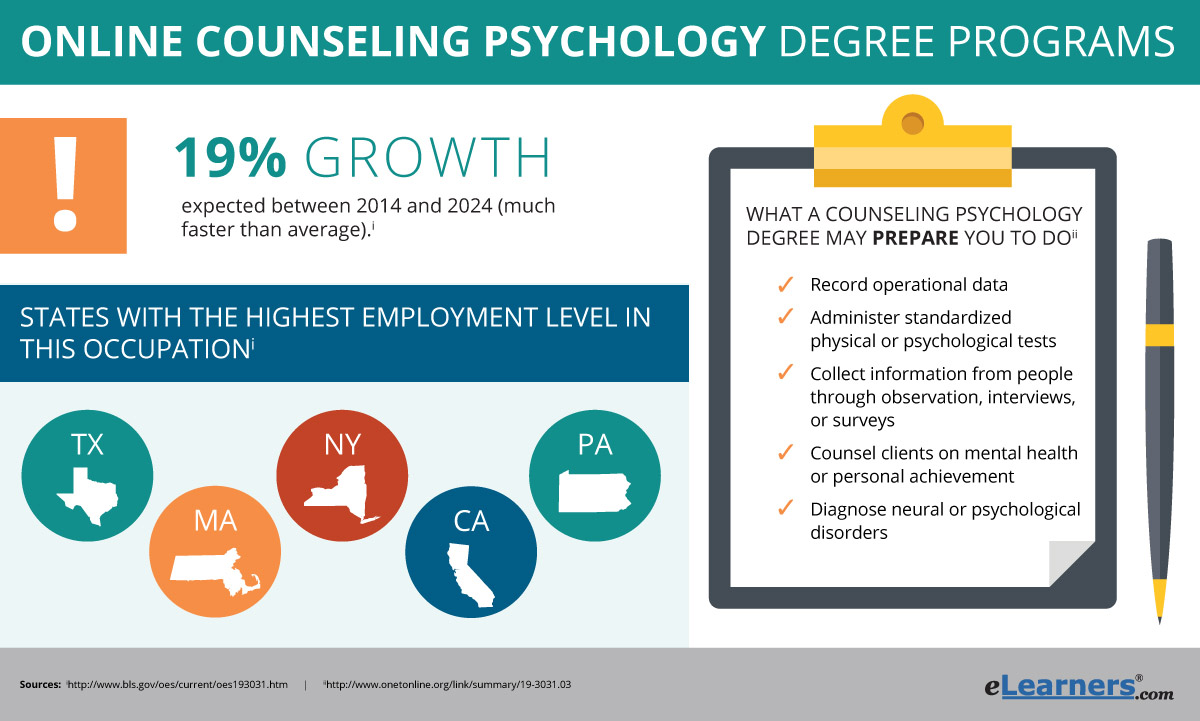
Online Counseling Psychology Degree Programs: Essentials
Whether you are thinking ahead to the title “psychologist” just want an undergrad degree, Online Counseling Psychology Degree Programs are offered as Bachelor’s, Masters and Doctorate degrees. Program prerequisites are likely to vary, so a good rule of thumb is to look ahead, prepare with the appropriate course of study and choose accredited programs. Keep in mind that there may be some overlap between social work and psychology, however there are distinct requirements for either choice.
Counseling Psychologist vs. Counselor
If you are considering an Online Counseling Psychology Degree but are confused by the terminology and how much education you need, know that there are some differences between counseling psychologists and counselors.
Both psychologists and counselors are mental health practitioners. Individuals in both fields have to be state licensed (which varies between states). However, there are some distinctions, both in their training and their scope of practice. There may be some overlap in course content, but degree outcomes are not necessarily interchangeable. So before you get started on a search, identify your academic needs and goals, and ask yourself whether you are interested in counseling in general or counseling psychology in particular.
Counselors (e.g. Social Workers, Substance Abuse Counselors, Mental Health and Marriage and Family Therapists) are typically required to have a master’s degree either in psychology, clinical mental health counseling, marriage and family therapy, or a related mental health field.[iii] Additionally, counselors have to go through post degree supervised work (internship or residency). Why? As stated before, this profession requires licensure and licensure requires a master’s degree and 2,000 to 4,000 hours of post degree supervised internship.[iv] Plus, counselors and therapists must pass a state-recognized exam and complete annual continuing education classes. In other words, if you do not wish to practice as a licensed psychologist but you are very much interested in understanding human thought and behavior, this might be a good fit for you.
STATISTICS SHOW: 57% of Substance Abuse Counselors have a master’s degree, 15% have a bachelor’s degree and 15% have a post-master’s certificate (O'Net)[v]
Psychologists, and that includes counseling psychologists, have education at the doctoral level. Programs in psychology follow standards and guidelines of the APA and include statistics and research. On top of that, psychologists use observation, assessment, psychoanalysis, or psychotherapy and experiments to find patterns of behavior or beliefs that influence the way their patients think and act. To work as a counseling psychologist, you need a doctorate in psychology, to fulfill internship requirements, at least 1 to 2 years of supervised professional experience, and to pass the Examination for Professional Practice in Psychology.[vi] If this is the vocation path you have in mind, select an Online Counseling Psychology Degree Program that supports your choice.
STATISTICS SHOW: 25% of counseling psychologists have a doctoral degree, 40% have post-doctoral training and 27% have a master’s degree.(O'Net)[vii]
Levels of Study in Counseling Psychology: Finding the ‘right’ program
Are you ready to search for an Online Counseling Psychology Degree? Online programs in Counseling Psychology offer students versatility and convenience. Depending on the type of career ambitions you have, there are different academic tracks with potential either for continued education or to enter the workplace – although there are certain guidelines and credentials needed for many positions, for instance, certificate programs.
To search on eLearners.com all you have to do is choose your degree level to browse listings for online degrees. You can also do your homework to determine the best education path for your goals, and contact the school for information or guidance.
Online Bachelors degrees in Counseling Psychology
Typically 4-year programs, students can choose the route of a psychology or counseling degree (e.g. Bachelor Social Work). Both the undergraduate degree in psychology, and Bachelor’s in Counseling might provide the foundation for the master’s or doctorate degrees as well as provide the credential increasingly required by employers for an entry-level job. Want to enter the workforce right away? Potential careers might include:
- Probation Officer
- Substance abuse counselor
- Business administration
- Sales
- Education
- Caseworker
Online Masters degrees in Counseling Psychology
A 2-year graduate degree might open more doors. For one thing, some masters in counseling psychology offer a thesis option for those interested in continued education. Interested in entering the workforce after graduation? Potential careers might include:
- Clinical Social Worker
- Marriage and Family Therapy
- Mental Health Counselor
- Psychological assistant (supervised)
- Industrial organizational psychologist
Online Ph.D. or Psy.D. degrees in Counseling Psychology
Depending on whether you prefer a research degree (PhD) or a clinical degree (PsyD), a doctoral degree is needed (along with licensure etc) for counseling psychologist professionals.
About Online
Distance learning is a convenient alternative to attending classes on campus, especially if you need to juggle work or family responsibilities. Bear in mind that social work and counseling psychology are human-centered fields so you should check whether there are on-site requirements (laboratory work, practicum, meeting with faculty etc.). Features of online study commonly include use of email, text, web cams, and a course management system that is used for learning delivery and submission of assignments.
Accreditation
Counseling psychology and social work are regulated. To qualify for licensure, candidates need to show they have graduated from an accredited program. This means the institution is accredited by state and regional agencies. Program accreditation will depend on what you are studying. Resources include the Council on Social Work Education (CSWE)[viii] and the American Psychological Association (APA)[ix]
Take the Next Step
If some of your skills include observation, listening, and empathy why not leverage them? Earning an Online Counseling Psychology Degree online may be a great way to boost your credentials, potentially open new professional avenues or continue your academic journey. Searching is simple, all you have to do is take the next step!
[i] apa.org/ed/graduate/specialize/counseling.aspx | [ii] bls.gov/ooh/life-physical-and-social-science/psychologists.htm | [iii] bls.gov/ooh/community-and-social-service/mental-health-counselors-and-marriage-and-family-therapists.htm | [iv] bls.gov/ooh/community-and-social-service/mental-health-counselors-and-marriage-and-family-therapists.htm | [v] onetonline.org/link/summary/21-1023.00 | [vi] bls.gov/ooh/life-physical-and-social-science/psychologists.htm | bls.gov/ooh/community-and-social-service/social-workers.htm | bls.gov/ooh/community-and-social-service/substance-abuse-and-behavioral-disorder-counselors.htm | bls.gov/ooh/community-and-social-service/probation-officers-and-correctional-treatment-specialists.htm | [vii] onetonline.org/link/summary/19-3031.03 | [viii] cswe.org/17491.aspx | [ix] apa.org/index.aspx