
Sponsored Online Programs Available

Online Engineering Degree Programs
If you are here it's because you are a thinker and a creator and want to learn more about pursuing that passion with an online engineering degree. Engineers design everything from bridges and engines to satellites and missiles and much more. With advanced mathematical principles and cutting-edge technology, they use their expertise to forge new paths in space, create functioning roadways in your home town or invent machines that change the world.
Engineering is an incredibly broad occupation and so is an online engineering degree. There are civil engineers, aerospace engineers, mechanical engineers, biomedical engineers and much more that use their talents to accomplish a flurry of tasks that are vastly different in scope in scale. Perhaps the only commonality between all fields of engineering is the strict adherence to mathematical principles that make solutions economical and feasible.
If you'd like to join the ranks of some of the world's most prominent problem solvers, an online degree in engineering may be a beneficial place to start. It may give you a better idea of the engineering principles and mathematics in fluid and solid mechanics you could end up using on a daily basis depending on what field you go into. Moreover, the online courses may give you a better idea of what you'd like to do in engineering whether it be aeronautics, mechanics, medicine or another area of expertise.
A glimpse into the realm of engineering
Engineers often work in office facilities, research departments or labs and occasionally visit work sites. They calculate, study and design devices and structures to accomplish whatever task their employer prescribes. Some may design medical solutions using biology or medicine to improve patient outcomes. Others may work with the government under certain security clearances to analyze, design and manufacture products used for national security. The work varies greatly, and with those differences come an equally diverse workplace and disparate daily tasks. Engineers often work as part of a team to accomplish goals, so communication and collaboration is of the utmost importance.
Is an online engineering degree right for me?
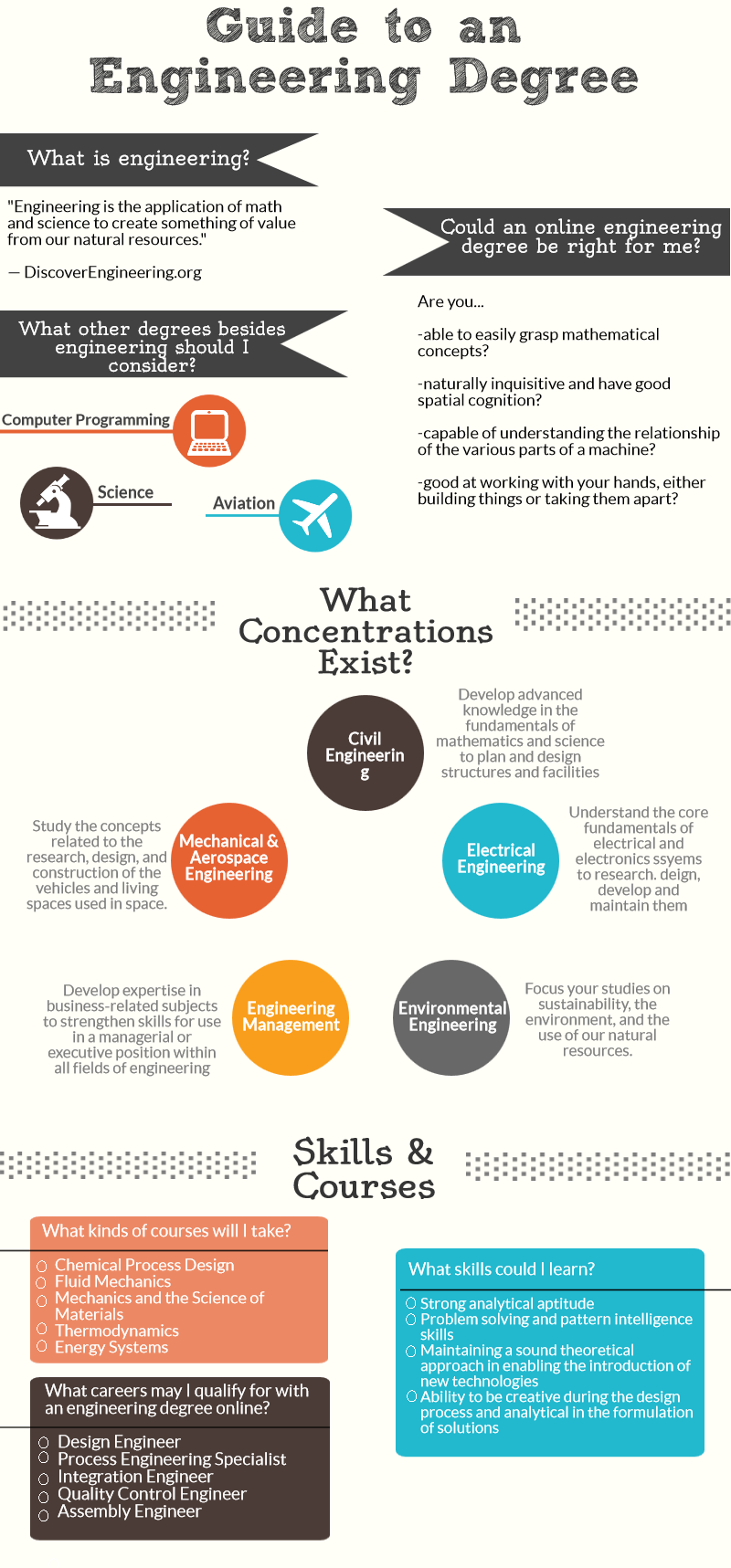
You should think about an online engineering degree if:
You are able to convey your thoughts both verbally and in writing, so that others can readily understand you.
You are able to easily grasp mathematical concepts and apply your knowledge to solve mathematical problems.
You are naturally inquisitive, always figuring things out, thanks to good problem-solving skills.
You are organized and determined, and are successful with long-term projects.
You can usually understand the relationship of the various parts of a machine as it functions with the whole.
You enjoy learning how things work, such as airplanes, suspension bridges, or telephones.
You consider yourself to be innovative, practical, with good foresight.
You enjoy working with your hands, either building things or taking them apart.
You have good spatial cognition, i.e. you can look at three dimensional objects, mentally manipulate them, and be able to accurately put them in perspective.
You like working within a team and collaborating with others and are able to recognize the value of others' work.
What concentrations exist for an online engineering degree?
Most schools of engineering will allow you to choose a specialization — a focused area of study within the online engineering degree.
Civil Engineering
Develop advanced knowledge in the fundamentals of mathematics and science in order to apply those skills to plan and design public and private structures and facilities, while understanding the impact of those structures on the greater community and society.
Electronics Engineering
Learn about developing new innovations and improving existing technology to better meet both organizational and societal needs concerning communications, computer hardware, etc.
Energy Utility Technology
Focus on being able to apply scientific knowledge specifically to the energy utility industry, including the planning, construction and maintenance of operations distributing many important resources such as natural gas, electricity, water, and telecommunications.
Electrical Engineering
Understand the core fundamentals of electrical and electronics systems in order to effectively research, design, develop and maintain them.
Engineering Management
Develop expertise in business-related subjects in order to strengthen skills for use in a managerial or executive position within all fields of engineering. Learn how to motivate others and facilitate communication clearly and effectively between engineers and non-engineering personnel.
Environmental Engineering
Enviromental engineering programs focuses on sustainability, the environment, and the use of our natural resources. Master the management of the effective use of resources, understand the vulnerability and nature of ecosystems and how engineering is used to negotiate the needs of nature and humankind.
Fire Protection Engineering
Learn the fundamentals of fire and about the technology and research utilized to maintain, control, and protect individuals from the fire and fire-related incidents. From the architecture design of fire escape plans to the development of flame-retardant materials, gain the skills to advance in the field of fire protection engineering.
Mechanical and Aerospace Engineering
Study the concepts related to the research, design, and construction of the vehicles and living spaces used in space or for travel through planetary atmospheres.
What skills will I learn in engineering degree online?
When you have completed your online engineering degree, you will likely have gained many of the following skills and competencies:
Ability to balance issues of costs, benefits, safety, and quality using one's professional judgement
Ability to maintain a sound theoretical approach in enabling the introduction of new technologies
Able to be both creative during the design process and analytical in the formulation of solutions to problems
Strong analytical aptitude
Careful attention to detail and willingness to think "outside the box"
Excellent problem solving and pattern intelligence skills
Familiarity with industry-specific technology, used with discerning judgment
Ingenuity and persistence
Skilled in oral speaking and presentation, as well as formulating persuasive arguments, especially when communicating technical information to non-engineers
Understanding of the economic, social, and environmental aspects of or impact upon a problem
Understanding of the impact of engineering solutions upon one's community and society as a whole
Willing to consistently use a systematic, iterative, approach to problem solving
Possible salaries for a career in engineering
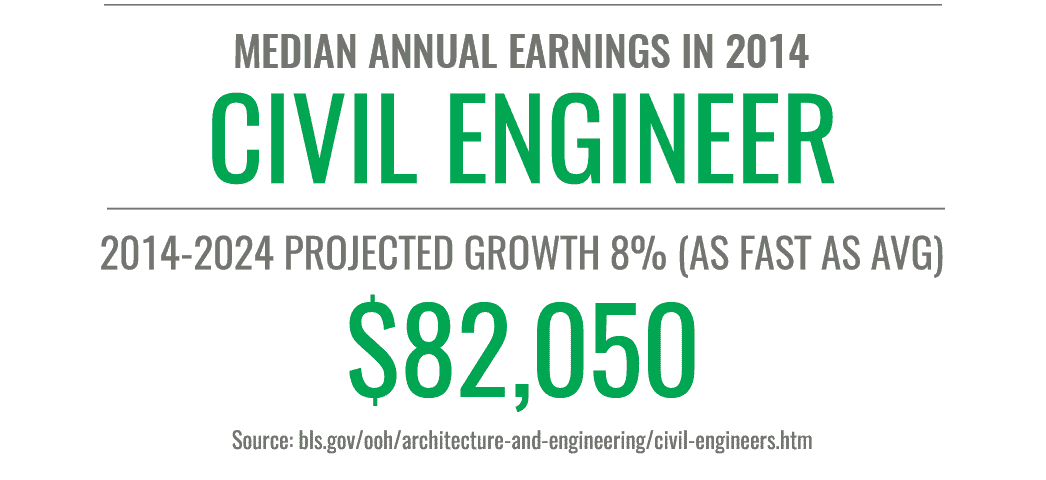
Your salary as an engineer depends largely on a wide array of factors, including your education, your specific job responsibilities and your level of experience and skill. Still, engineers in different fields make various amounts as well. The salary for an aerospace engineer is often different from the salary or a mechanical engineer and so on. Consider the following careers, with statistics compiled by the BLS in 2012.
- Mechanical engineers: 2012 Median annual salary of $80,580 (5 percent projected growth through 2022)[i]
- Aerospace engineers: 2012 Median annual salary of $103,720 (7 percent projected growth through 2022)[ii]
- Biomedical engineers: 2012 Median annual salary of $86,960 (27 percent projected growth through 2022)[iii]
Additional skills important for a career in engineering
Do not underestimate how much math is necessary to become an engineer. Professionals in this field may use advanced trigonometry and calculus principles on a daily basis. It is absolutely imperative for an engineer to be comfortable with numbers and proficient with equations. If mathematics is one of your strong suits, an occupation in engineering may be the perfect path for you.
[i] bls.gov/ooh/architecture-and-engineering/mechanical-engineers.htm | [ii] bls.gov/ooh/architecture-and-engineering/aerospace-engineers.htm | [iii] bls.gov/ooh/architecture-and-engineering/biomedical-engineers.htm