
Sponsored Online Programs Available
Pursuing an Online Fashion Merchandising Degree
Earning an online fashion merchandising degree or certificate helps students learn how to create fashion and move fashion merchandise from source to producer to retailer to consumer. Through their studies, students explore an ever-evolving field and learn how to develop products and gain strategic advantage in the fashion industry.
Getting an education in the theories, practices, and applications of fashion merchandising—whether at the certificate or associate, bachelors, or masters degree level—might be your key If you’re wondering how to get into the fashion industry.
What Will I Learn by Earning a Fashion Merchandising Online Degree or Certificate?
Through classes across disciplines, you’ll study key components of fashion merchandising as you pursue your online fashion merchandising degree or certificate. For example, you may learn about:
- Business (accounting, marketing, managing, and other key areas)
- Merchandising (marketing, designing visual displays, and otherwise promoting goods)
- Design (sourcing, designing, and creating fashion and other products)
To better understand fashion as an industry, you might study:
- The history and future of fashion
- Fashion merchandising
- Visual merchandising
- Merchandise planning and strategy
- Sustainability in fashion
- Forecasting in retail
- Supply chain management
- Consumer behavior
To develop your creativity and fashion know-how you might study:
- Fabrics and textiles
- Color theory
- Pattern design
- Sewing
- Draping
- Costume making
To cultivate your business acumen, you might study:
- Micro and macro economics
- Business law and ethics
- International business
- Operations management
- Finance
- Fashion marketing and management
You may also learn about fashion and its components (textiles, fabrics, artistry, and trade, for example) by studying anthropology, sociology, and even politics. For example, you may study:
- Trends as a sociological phenomenon
- Clothing as spiritual, religious, or otherwise sacred items
- Trade policy and the impacts of merchandise trade on local, national, or global politics
In this way, many online fashion merchandising degree and certificate programs take an interdisciplinary approach to illustrating fashion merchandising as a field and discipline.
What precisely you’ll study and to what depth depends on what certificate or degree you’re pursuing and the program’s curricula and purpose. Some certificates and degrees might emphasize business or industry while others might emphasize the art of fashion. Some might balance amongst the three.
If you pursue an associates or bachelors degree, you’ll also study subjects such as English, science, social science, math, and technology as part of your general education curriculum.
Why Pursue an Online Fashion Merchandising Degree or Certificate?
Fashion merchandising is a broad field covering a full spectrum of design, industry, and business ideas and applications. Earning an online fashion merchandising degree can help students delve into these subjects that help make sourcing, designing, buying, merchandising, and selling fashion and other retail a success.
Consider for a moment all that’s involved in fashion merchandising:
- Designing fashion lines and creating patterns.
- Finding textiles, fabrics, and other materials.
- Sewing and making clothing and accessories.
- Selling, buying, and trading products within the industry (from a village in South Africa to a merchandiser, for example, or from a producer to a retailer).
- Marketing and merchandising fashion.
- Managing the exchange between seller and consumer.
- Managing the process and the people involved in the process throughout.
Now consider the skills and knowledge professionals must have to work effectively and creatively in these areas. The demands are immense. Understanding the theory, practices, and dynamics that influence these steps and the process overall gives one an advantage. Without a degree, prospective professionals in the field might find themselves unequipped in a competitive field. Why not earn a certificate or degree to boost your know-how and add an enticing element to your resume?
What Kinds of Degrees and Certificates Can I Pursue in Fashion Merchandising?
You have many options for pursuing an online fashion merchandising degree. You can earn:
- An associates degree
- A bachelors degree
- A certificate
- A masters degree
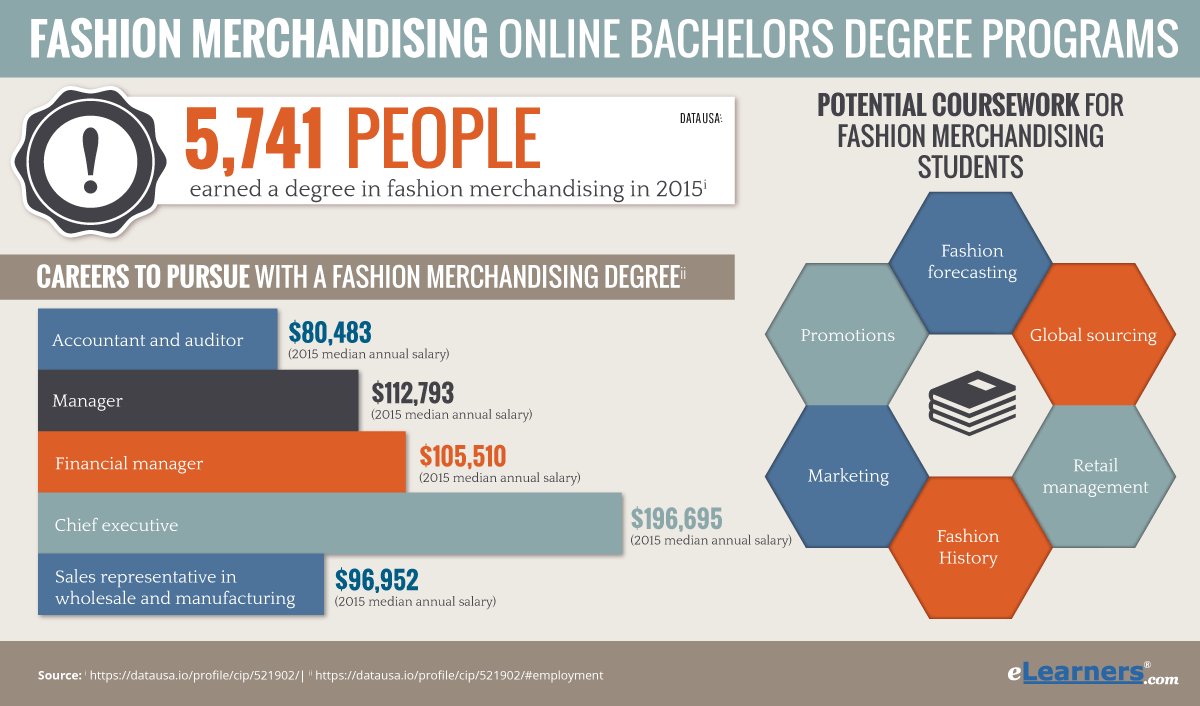
In 2015, the two most commonly awarded degrees in fashion merchandising were bachelors and associates degrees. That same year, 3,083 students earned bachelors degrees in fashion merchandising and 2,507 students earned associates degrees in the subject.
After bachelors and associates degrees, the next highest number of students pursued certificates in fashion merchandising.i
Associates Degrees in Fashion Merchandising
At the associates degree level, students can earn:
- An Associate of Science (A.S.)
- An Associate of Applied Science (A.A.S.)
- An Associate of Arts (A.A.)
While the A.S. and A.A. take a more academic approach to educating students, the A.A.S. takes a more technical approach. A.S. and A.A. degrees typically prepare students to learn more—either by becoming employed at entry-level positions in the field or transferring to a bachelors degree program. Meanwhile, an A.A.S. typically delivers to students a ready-to-use technical skill that can be immediately applied to the industry. Learn more about online associates degrees in fashion merchandising and explore your options here.
Keep in Mind:
- You must have a high-school diploma or GED to pursue an associates degree.
- Ten or so classes of your degree will likely be devoted to general education.
- The other 10 or so classes will be devoted to your fashion merchandising major.
- Many students transfer associates degree credits into bachelors degree programs; an associates degree could therefore be a final destination or a starting point.
Typical Time to Degree: 2 years of fulltime study
Bachelors Degrees in Fashion Merchandising
Bachelor of Science (B.S.) and Bachelor of Arts (B.A.) degrees sometimes vary in terms of what type of curricula they offer. In fashion merchandising, B.S. degrees might emphasize business while B.A. degrees emphasize design. But this is not always the case. Ultimately students should look at B.S. and B.A. curricula to determine whether or not the degree meets their needs.
Students’ B.S.s and B.A.s might be in fashion merchandising, or they might be in business or fashion design with an emphasis or concentration in fashion merchandising. Learn more about online bachelors degrees in fashion merchandising and explore your options here.
Keep in Mind:
- You must have a high school diploma, GED, or associates degree to pursue a bachelors degree.
- Twenty or so classes will likely be devoted to general education.
- The other twenty or so classes will be devoted to your major in fashion merchandising.
- Your bachelors degree is complete in and of itself. You cannot transfer it into another program. However, having a bachelors degree does make you eligible to apply for a masters degree program.
Typical Time to Degree: 4 years of full-time study.
Certificates in Fashion Merchandising
At the certificate level, students can earn:
- A certificate of completion
- A Fashion Merchandising Certificate
- A Fashion Business Certificate
Certificates are not degrees. They enhance degrees or serve as a first step toward a degree. Therefore, they might have more designations than degrees do. The three mentioned above are just some examples.
Fashion merchandising certificates might focus on fashion merchandise in general, or they might emphasize one or two components of fashion merchandising such as fashion marketing and management, fashion retail, or fashion design. Some certificates might drill down beyond those categories into subcategories such as visual displays, international retail, or costume design. Learn more about online certificates in fashion merchandising and explore your options here.
Keep in Mind:
- There are two types of certificates in fashion merchandising: undergraduate or graduate. To pursue an undergraduate certificate, you must have a high school diploma, GED, or be pursuing an associates or a bachelors degree. To pursue a graduate certificate, you must have a bachelors degree.
- All five to ten of your courses will be devoted to fashion merchandising or a specific subject connected to fashion merchandising.
- Students can sometimes transfer certificate credits into an associates, bachelors, or masters degree program. Therefore, certificates can serve as a stopping point or starting point depending on your goals.
Typical Time to Certificate: 6 months to one year of fulltime study.
Masters Degrees in Fashion Merchandising
At the masters degree levels, students can earn:
- A Master of Science (M.S.)
- A Master of Art (M.A.)
- A Master of Business Administration (M.B.A.)
All three of these degrees might be in fashion merchandising (with the M.B.A. emphasizing fashion merchandising) or a closely related subject such as apparel design, retail merchandizing, or fashion management. Learn more about online masters degrees in fashion merchandising and explore your options here.
Keep in Mind:
- To pursue a masters degree, you must have a bachelors degree.
- All 20 or so courses will be devoted to your major in fashion merchandising. Some of your courses will fulfill core requirements; others will fulfill elective requirements.
- Masters degrees in fashion merchandising are complete in and of themselves. Students do not typically transfer them into other programs. However, in some cases, students can transfer them into compatible doctorate programs.
Time to Degree: 2 years of full-time study.
What Skills Might I Develop When I Pursue My Fashion Merchandising Degree Online?
Doing coursework, utilizing online technology, and engaging with instructors, classmates, and professionals can help you develop your skills in fashion merchandising. Keeping in mind that many certificate and degree programs’ curricula help students develop industry-critical skills, here are some key skills of fashion merchandisers:i
- Persuasion
- Judgement and decision-making
- Social perceptiveness
- Negotiation
- Complex problem-solving
- Speaking
- Writing
- Active learning
- Active listening
- Reading comprehension
- Critical thinking
- Systems evaluation
- Instructing
- Service orientation
- Coordination
As you earn an online fashion merchandising degree or certificate, soft and technical skills like these may become your forte.
What Should I Keep in Mind as I Consider Earning an Online Fashion Merchandising Degree or Certificate?
Here are 4 things to keep in mind as you determine what level of degree or certificate to pursue:
- What education do you already have? Do you have the diploma or degree required to take the next step you want to take?
- How much time and money do you have to devote to school? Can you devote six months to one year? Two years? Four years? How much money do you have to devote to education? Answering these key questions could help you determine what’s right for you at this point.
- Any online fashion merchandising degree or program can be intense and challenging. However, earning a masters degree is generally more challenging than earning a bachelors degree and earning a bachelors degree more challenging than earning an associates degree. Why? Because the higher degree, the more upper division courses you’ll be taking. Upper division courses generally require more reading, writing, and critical thinking. Earning a certificate could be more or less challenging than earning a degree depending on the level of courses and the program. How much mental effort can you afford to put into earning your degree and certificate right now?
- Typically, the more classes you take, they more you’ll spend time developing your skills and knowledge. Pick a certificate or degree level that will help you develop your talents as fully as you’d like to.
Choosing Your Subjects
There are also some things to keep in mind as you consider what subject to study:
- Some certificates and degrees cover fashion merchandising broadly; others cover a specific component of it. Do you want to engage in a more shallow exploration of more components of fashion merchandising? Or do you want to engage in a more in depth exploration of fewer components of fashion merchandising?
- Do you want the breadth of your skills and knowledge to be in fashion? If so, consider pursuing a degree or certificate in fashion with an emphasis on business and merchandising.
- Do you want to breadth of your skills and knowledge to be in business? If so, consider pursuing a degree or certificate in business with an emphasis on fashion merchandising.
- What online fashion merchandising degree or certificate will best help you meet your professional goals? Remember that you can pursue degrees or certificates in quite specific subjects—retail management, alteration specialist, or fashion marketing, for example. Choose one that fits your educational and professional needs.
Finally, keep in mind that as a student pursuing an online fashion merchandising degree or certificate, you might have options to expedite or slow down your studies depending on your work pace and schedule. You might also have options to take time off and therefore take longer than average to earn your certificate or degree. If your lifestyle requires flexibility, find an online fashion merchandising degree or certificate whose schedule meets your needs.
Which Fashion Merchandising Degree Is Suited for Me?
Now is a great time to explore the answer to that question. You now have a sense of what education is available in fashion merchandising. Your next mission is to browse through certificate and degree programs to see what specific programs suit you. Do you want to pursue a retail management degree? A fashion marketing degree? A business fashion degree? Do you want to earn a certificate to test the waters of fashion merchandising or enhance your existing education? Knowing the answer to questions like these can help guide your search. So too can our site.
Use our menu to choose a degree level. Once you’ve landed on your preferred page, explore options for online fashion merchandising degrees or certificates. You can find information on accreditation, online options, and more. You can also request additional information about programs you like most.
Jump right in and take the next courageous step in pursuing your dreams. Your path awaits!
Source: datausa.io/profile/cip/521902/