
What is a diploma mill?
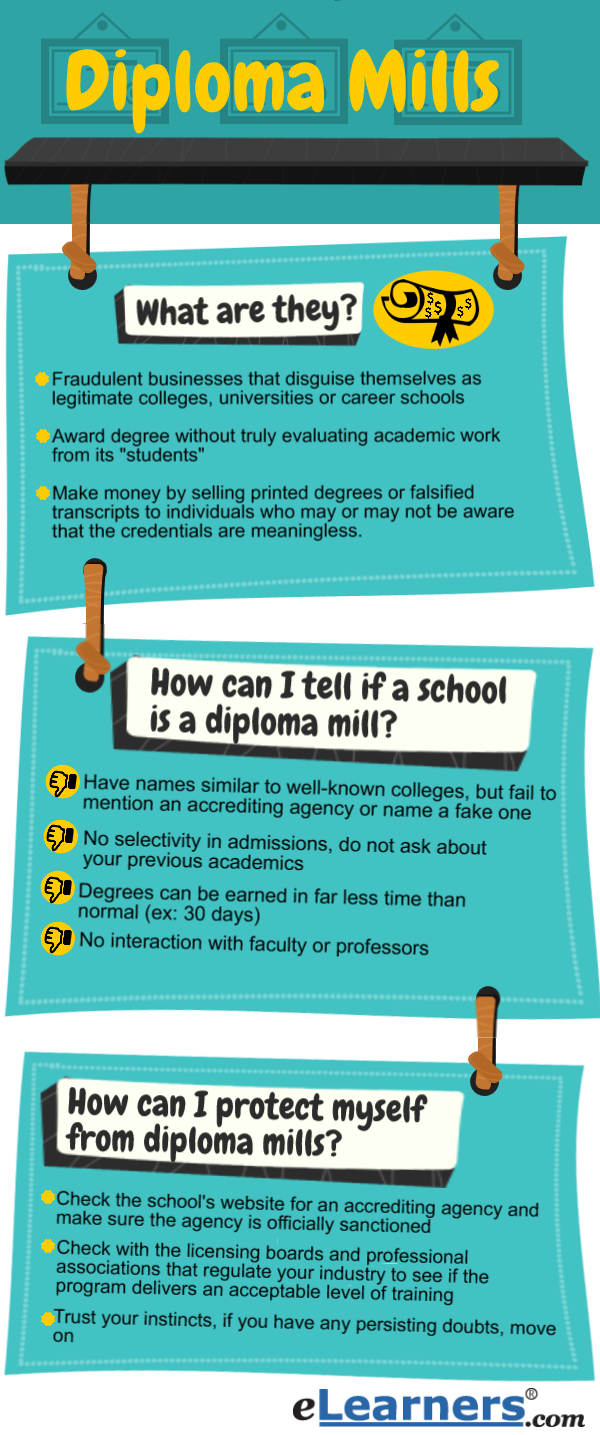
A diploma mill is a fraudulent business that disguises itself as a legitimate college, university, or career school. A diploma mill (or "degree mill") will pose as a real university, and award degrees without truly evaluating academic work from its "students." Diploma mills make money by selling printed degrees and providing academic references or falsified transcripts to individuals who may or may not be aware that the credentials are meaningless.
A degree mill may sell degrees at all levels, from bachelor's degrees to doctoral degrees. A degree mill might also allow its customers to pay higher rates for academic honors (like summa cum laude). Degree mills typically attract two types of customers:
Individuals searching for a genuine academic program, who are unaware that they are enrolling at a degree mill.
Individuals who are aware that they are committing fraud, but nevertheless want to build their credentials quickly for academic or professional reasons.
How do diploma mills get started?
Online education is still a fairly new option in the world of colleges and universities. Traditional colleges and online colleges develop new programs every day, according to the career needs of changing student populations. It's difficult to keep track of all the new schools and new degrees that enter the higher education arena. And since Web sites are fast and easy to build, a fraudulent school can create a convincing facade - one that mirrors the look of a legitimate online school.
Can you provide a specific example of a diploma mill?
There are two kinds of diploma mills: those that offer low quality courses, and those that merely sell you a piece of paper with your name on it.
One noteworthy example of a diploma mill involved Brian McNamee, a personal trainer for professional baseball athletes, including Roger Clemens. Reportedly, McNamee earned his doctoral degree from Columbus University, a diploma mill that had operated out of Mississippi, Louisiana, and Alabama.
On its Web site, Columbus University claims to be, "The Established Name in Distance Education," and also claims to be accredited by the Adult Higher Education Alliance. This is a fake accrediting agency.
The Adult Higher Education Alliance is not recognized by the U.S. Department of Education. The U.S. Department of Education's Web site lists several established accrediting agencies including the Distance Education and Training Council (DETC) and the Accrediting Council for Continuing Education and Training (ACCET).
And there are other indicators that demonstrate Columbus University's illegitimacy. If you look up the registration information of the school's Web site, you can see that they list a third party company rather than a mailing address. This is not typical for a legitimate educational provider. Most schools disclose their complete contact information and mailing addresses with their registration information. Diploma mills have every reason to hide and mask their location, because they sell fraudulent degrees.
How can I tell if a school is a diploma mill?
They often have names similar to well-known colleges or universities, but fail to mention an accrediting agency or name a fake accrediting agency.
The organization frequently changes addresses, sometimes moving from state to state.
Written materials typically include numerous spelling and grammatical errors, sometimes on the diploma itself.
Overemphasis on the speed and brevity with which someone can receive a degree (e.g. "Call now and have your degree shipped to you overnight!").
Degrees can be earned in far less time than normal (e.g. 27 days) or the diploma is printed with a specific backdate.
There is no selectivity in admissions, or any questions about previous test scores or detailed academic history.
No interaction with professors or faculty (e.g. only two emails are received from a professor).
Degree requirements are vague or unspecified, lacking class descriptions and without any mention of how many credit hours are required to complete a program.
Tuition and fees are typically on a per-degree basis.
Grade point average (GPA) and academic honors (e.g. Summa Cum Laude) can be specified at the time of purchase.
What's being done about these degree mills?
Unfortunately, fraudulent schools continue to spread and are increasingly sophisticated in their scams. These diploma mills survive by operating in states that lack strict laws regarding school accreditation, such as California, Utah, Hawaii and Louisiana. They assume identities of well-known schools, or market themselves as a religious organization.
Because of constitutional safeguards, the United States guarantees separation of church and state. Most states are reluctant to pass any laws restricting the activities of churches, including their right to grant degrees. Diploma mills take advantage of this reluctance.
To further protect themselves and to take advantage of less rigorous laws, diploma mills often operate out of multiple political jurisdictions. They sell degrees only in other states or other countries. Many degree mills operate from England, selling fake degrees only to people in other countries, primarily the United States, Africa, and Asia.
It can sometimes be difficult to prove fraud in the case of a diploma mill. In some cases, a diploma mill may immunize itself from prosecution by being forthcoming about its business, fully acknowledging that it is a diploma mill. The individuals that buy degrees from this particular type of diploma mill are fully aware that they are getting a degree without having to complete any academic work. In this case, the diploma mill is arguably acting only as a business.
It is very risky to buy a fake degree, or claim to have a degree without having completed an accredited degree program. Consumers with bogus degrees are liable to find themselves embarrassed professionally, or even out of a job. The most severe consequence is having to face criminal charges. In Oregon, it is illegal to use a degree from an unlicensed institution to get a job or gain a promotion.
How can I protect myself from diploma mills?
If you are looking to enroll in a degree program, it is important to research your online school thoroughly. If you have any doubts about an online program, take the following precautions:
Check the school Web site, to see if the school is accredited. If an agency is named, check to see if that accrediting agency is officially sanctioned. Legitimate accrediting agencies are recognized by the U.S. Department of Education and/or the Council for Higher Education Accreditation. Both of those organizations list legitimate agencies on their Web sites.
Check with the licensing boards and professional associations that regulate your industry to see if the program delivers an acceptable level of training.
Don't conduct your college research through newspaper classified ads.
Call or write the Better Business Bureau and the attorney general's office to make sure the school is operating legally in its home state. Ask if any complaints have been filed against the school.
Ask about the school's faculty: Who teaches the courses? What degrees do they have? What is their area of expertise?
How are fake degrees sold?
At first glance, diploma mills may be difficult to detect. Their Web sites contain scenic campus photographs and promises of a dedicated faculty. Some diploma mills send vague email advertisements. Typically, the email doesn't mention a college or university name. Most simply state, "earn a degree from a prestigious, non-accredited university," and list only a phone number.
If you respond to a diploma mill ad, the customer representative is likely to deliver some (or all) of these sales pitches:
"Receive your degree from a prestigious, non-accredited university."
"Do you want a diploma without the dreary classes, droning professors and annoying exams?"
"You can receive a diploma from our university based on your present knowledge and life experience. No classes necessary!"
"There will be no required tests, classes, books or interviews."
"Bachelor's, master's, and doctoral degrees are available in the field of your choice."
"You have been selected to earn your MBA."
"$425 will certify you for a bachelor's degree from John Doe University."
"You will receive your diploma within days.
"With an additional payment of $75 in tuition, you will earn Magna Cum Laude."
"If you enroll today, we will send you your diploma, a laminated, wallet-sized replica of your diploma, honors of your choice, transcripts, and letters of recommendation."
"You will receive unlimited support from us, including verification of your credentials to prospective employers."
"Get your bachelor's degree AND a master's degree today for $1,200."
Online learning is fast
But not that fast. Don't confuse accelerated degrees (which are offered by many legitimate online schools) with instant degrees (which are fake.)
Many online schools offer students the ability to earn their degree at an accelerated rate. Earning your MBA in as little as 10 months, for instance, is not an uncommon feature of online business colleges. But this does not mean less work. Rather, it means the online format allows you to participate in online classes, lectures, and projects as quickly as you can properly complete the required assignments.
If you encounter a school that offers you an "instant degree" or anything similar, you're looking at a scam. Any worthwhile degree will involve the completion of specific courses. Each course should involve new content lessons, graded assignments and/or graded exams.
Trust your instincts
If you have any persisting doubts, move on. There are a lot of schools out there. Most have them have quality programs to offer. You can also rest assured that the colleges and universities listed on our site are, without exception, well-respected and well-known. We have established, active relationships with all of them. So if you find a program on our Web site, you can trust that it is reputable.