
Sponsored Online Programs Available
Online Property Management and Real Estate Degrees
Depending on the level of online real estate degree or online property management degree you pursue, top programs examine a range of topics from the basic fundamentals of real estate principles to a comprehensive understanding of theories and research. In order to best teach a business foundation, courses may cover finance, statistics, and economics, as well as real estate market analysis, legal aspects of real estate, and principles of property management.
Did You Know?
According to Pew Research Center, more U.S. households are headed by renters than at any point since at least 1965, when data collection began.
Online Real Estate Degree: Essentials
One of the most important aspects of pursuing an online real estate degree is understanding the different requirements for the licensing exams and any other entry requirements. Real estate is a broad subject with many facets.
Therefore, depending on the degree level you pursue, subject matter may vary. For instance, many undergraduate programs are designed to provide a fundamental basis so that graduates can pursue entry-level positions. On the other hand graduate degrees are designed to teach a complete understanding of the subject matter and typically include more critical analysis and research.
5 Key Topics All Pros Should Know!
Some of the other key topics you may study while pursuing an online real estate degree include how to:
- Identify the key principles, practices, legal and ethical issues in real estate
- Examine how laws and governance in real estate help customers
- Discern how economic, demographic, dynamic, and market trends influence real estate valuations
- Advise clients on prices, mortgage conditions, and related information
- Understand marketing principles in order to promote propertiesi
Online Property Management Degree: Key Skills & Knowledge
It's easy to confuse real estate degrees with an online property management degree. While you may take a number of similar courses in property management as you doin real estate, many of the courses and topics you may examine focus more treating each property as a business, creating profit and loss (P&L) statements, and how to perform at least basic repairs in case of damage.
5 Must-Have Skills!
Some of the key skill sets in property management include how to:
- Define business concepts related to property management, such as advertising, marketing, cash flow, profit and loss, and capitalization rate
- Describe the different types of properties and explain the different types of tenants such properties attract
- Explain the importance of risk management and assess liability in order to secure adequate liability insurance
- Operate and maintain mechanical systems in buildings
- Understand various ways of improving and increasing property valuesii
Online Associates Degree: Real Estate and Property Management
Typically, online real estate and property management associates degree programs require students to complete around 60 credits, though some schools may require as many as 72 or 80 depending on the unique design of the program and your major.
Most full-time students can earn an associates degree in two years by taking five courses a semester. Part-time students may take fewer courses per semester in order to have more flexibility, though this usually makes it take longer to earn your degree.
Some associates programs that offer an online real estate degree or an online property management degree also have transfer agreements with four-year universities. Therefore, these programs are designed to fulfill many of the general education requirements of these schools and may make it easier for you to transfer in order to pursue a four-year degree. However, this may not be offered at every school, so be sure to check with a number of options before applying.
Admissions Requirements for Associates Degree
FOUR common admissions requirements for an online associates degree in real estate and property management include:
- High School Diploma or GED Equivalent Diploma
- Complete Application
- Official Transcripts
- Complete Placement Assessment Test
Keep in mind that every school has unique admissions requirements, so be sure to check with them before applying.
Common Property Management Courses Online: Associates Degree
Many of the courses you may take while pursuing an associates in project management or online real estate degree are considered foundation courses. Therefore, they focus oncovering the general principles. Typically, this degree is viewed as a stepping-stone that may allow graduates to pursue entry-level positions or to further their education with a bachelors degree.
FOUR common courses include:
- Principles of Real Estate
- Real Estate Law
- Real Estate Math
- Property Management
Most associates degrees also require students to take a number of general education courses, which is another factor in helping students pursue a bachelors degree.
Online Property Management and Real Estate Bachelors Degrees
Many online real estate and property management bachelors degree programs require students to earn roughly 120 credits. Although, these requirements may vary depending on the unique design of the school and program.
Typically, full-time students earn their degree in four years, but many online schools offer you the ability to take courses around your busy schedule. While this may provide more freedom, it may take part-time students longer to earn their bachelors degree.
The TWO Types of Bachelors Degrees in Real Estate and Property Management:
Usually, there are 2 types of bachelors degrees available in real estate and property management. These are both academically equivalent and usually have similar requirements. The two types are:
1. Bachelor of Arts (BA)
BA degrees are usually more focused on providing a well-rounded education to students. Therefore, they may require more liberal arts courses, such as history, art, mathematics, or social sciences. While pursuing a BA, you may take fewer courses in real estate or property management and replace those credits with more electives.
2. Bachelor of Science (BS)
On the other hand, BS degrees are usually focused on technical, scientific, or business majors. Many programs are designed with more emphasis in real estate and property management, with a more structured curriculum with fewer opportunities to take electives.
Admissions Requirements for Bachelors Degree Programs: Online Real Estate Degree
While the specific admissions requirements vary from school to school, some of the most common include THESE FOUR:
- High School or GED Equivalent Diploma
- Official Transcripts
- SAT or ACT Scores
- Completed Application
Keep in mind that some schools that offer an online real estate degree have stricter requirements than others, such as a minimum GPA of 3.0 or higher, or minimum standardized test scores. Check with a few different schools to find one that matches your goals.
Common Courses: Online Bachelors in Real Estate and Property Management
In addition to taking a number of courses in your major, whether real estate, property management, or some variation of the two, many bachelor degree programs require you take a number of general education courses in order to teach a well-rounded education.
FIVE courses you may take in real estate and property management include:
- Hospitality Facilities Management
- Principles of Property Management
- Real Estate Market Analysis / Investment Analysis
- Legal Aspects of Real Estate
- Commercial Real Estate Investment
Real Estate and Property Management Certificate Online
As shorter, non-degree programs, certificates are usually designed for working professionals in order to teach specific aspects of real estate and property management. As a result, the amount of courses required to earn your certificate vary from six to nine.
How Long Will It Take?
Many students can earn their certificate in a year, but some programs recommend you take longer to account for your responsibilities outside of the classroom.
Keep in mind that certificates are not the same as certifications or licensures. Typically, these programs are designed to teach you the principles of real estate or property management and may prepare you for licensure in your state, but earning a certificate does not grant you licensure in your respective state.
Admissions Requirements for Real Estate and Property Management Certificates
Every school has unique admissions requirements for online certificate programs.
However, here are FIVE of the most common,listed below.
- Bachelors Degree from an Accredited University
- Completed Application
- Official Transcript
- Letters of Recommendation
- Resume
Some schools may have additional requirements, such as requiring students compose an essay or personal statement describing why they want to attend this program. However, check with your favorite programs that offer an online real estate degree or property management degree to see specific requirements before applying.
Common Online Certificate Courses
As opposed to undergraduate degrees, many certificates do not require that you take any general education courses. Instead, online real estate and property management certificates may ask that you take an introductory course to the topic or major to provide a foundation for all students. Then all other courses build upon that foundation to analyze a particular aspect of the field more in-depth.
While courses vary depending on the concentration you’ve selected, THEFIVE MOST common courses you may take while pursuing an online real estate and property management certificate include:
- Managing Building Maintenance and Tenant Relations
- Financial Accounting and Property Valuation
- Property Management: Multifamily and Community Associations
- Risk Management and Fair Housing
- Real Estate Leases and Transactions
Online Master of Property Management and Real Estate
An online masters degree in real estate and property management teaches advanced academic and professional acumen to meet the evolving challenges in the field. Many programs are designed to emphasize the application of theories and research based on real-world challenges.
Depending on the unique design of each program, masters degrees usually require students complete 33 to 48 credits. Many full-time students may earn their masters degree in two years, however, it takes longer for part-time students.
THE THREE Types of Master Degrees in Real Estate and Property Management
There are a number of different types of masters degree designations available for an online real estate degree and an online property management degree. While there are some differences, keep in mind that each of these are academic equivalent and usually take about the same amount time for students to earn.
1. Master of Science (MS)
Typically, a MS is a more focused degree and many only include courses in real estate or property management, depending on the major you’ve chosen. While you may take business courses, typically they will be oriented specifically to real estate or property management.
2. Master of Professional Studies (MPS)
Similar to a MS, MPS degrees are usually more focused on real estate or property management. Therefore, your courses will focus on the different components of your chosen major and the business principles associated with it.
3. Master of Business Administration (MBA)
An MBA is a widely recognized degree that may provide a more well-rounded business curriculum to students. This may include a curriculum that combines overall business courses such as marketing, economics, and statistics with a number of courses in real estate and property management.
Online Masters Degree Admissions Requirements
FOUR of the most common admissions requirements for online masters degrees in real estate and property management include:
- Bachelors Degree from an Accredited University
- Personal Statement
- Resume or CV
- Official Transcripts
Some schools may require that you earned your bachelors degree with a minimum GPA, such as a 3.0. Other schools may allow you to substitute GMAT scores to make up for a lack of professional experience or minimum GPA requirements. Therefore, be sure to check the specific requirements of each of your favorite schools before applying.
Online Property Management and Real Estate Masters Degree Courses
While earning an online masters degree in real estate and property management, courses are designed to show students a comprehensive view of the principles of the field. This normally includes applying theories and research to real-life case studies and examples.
FIVE of the common courses include:
- Development and Construction Property Management
- Impact of Globalization on Real Estate
- Sustainable Development and Construction
- Real Estate Finance
- Real Estate Analysis
Online PhD in Real Estate and Property Management
While pursuing an online PhD in real estate and property management, programs teach how to engage in productive scholarly research. Typically, this is by placing a greater emphasis on reading, writing, and critical analysis than other degree levels. Many programs analyze real estate, economics, quantitative methods, and finance among other subjects.
Many students can earn a PhD in four to five years, depending on the structure of the program. This usually includes proposing, writing, presenting, and defending a dissertation to a board of faculty.
Many programs also require you to pass at least one comprehensive exam, while some programs require two.
FIVE Admissions Requirements for Online PhD in Property Management and Real Estate
The most common admissions requirements for online PhD programs in real estate and property management include:
- Masters Degree from an Accredited University
- Official Transcripts
- GMAT or GRE Scores
- Letters of Recommendation
- Essay or Statement of Purpose
In order to find the perfect online real estate degree for you, be sure to check with a number of different options to find a program that meets your current academic standing.
Common Online PhD Courses
Many doctoral degrees require a number of courses in finance, economics, and statistics in order to teach qualitative and quantitative research methods. Some programs also require at least one econometrics course, which uses mathematical methods and statistics to describe economic systems.
Some of the common doctoral-level courses in real estate and property management online include:
- Econometrics
- Corporate Finance Theory
- Real Estate Investment
- Discrete-Time Asset Pricing
- Continuous-Time Finance
Different Types of Online Real Estate and Property Management Degrees
When deciding to pursue an online real estate degree or an online property management degree, keep in mind there are a number of variations. Some of these are more general, such as real estate studies, whereas other degrees are more focused, such as commercial property management.
As a result, check out some of the different options below in order to find the perfect program for you.
Real Estate Studies
As domestic and global real estate markets are transformed by new laws, governance, codes, and an increasing emphasis on sustainability and green construction, a real estate studies degree is built on a solid liberal arts and business foundation.
Real estate studies programs examine the markets and financing methods for both residential and commercial properties, as well as the trends that impact property valuations. Some programs even provide students with professional exposure through corporate tours, professional forums, and other opportunities to interact and network with real estate professionals.
By focusing on analytical and critical thinking skills, real estate studies degrees teach topics such as:
- Mortgage banking
- Institutional lending
- Real estate appraisal
- Real estate investment consulting
- Corporate real estate
Courses also analyze the legal and ethical aspects of the modern, competitive real estate markets. This may include why they are in place and how they help clients. In addition to real estate courses, many programs also require students to take classes in accounting, statistics, marketing, and management to teach a complete business foundation.
Real Estate Property Management
Designed to teach the principles of the changing international real estate market, real estate property management degrees combine market analysis, sales, and business acumen, with the legal and ethical regulations in real estate.
Typically, these programs are designed to teach a foundation in the principles of both real estate and property management. Therefore, courses teach business principles such as:
- Finance
- Marketing
- Management
- Economics
In addition to the business courses. . .Real estate property management degrees also examine topics such as:
- Design
- Construction and development
- Sales and leasing
- Real estate development
- Property asset management
Since this degree is usually focused on providing a foundational understanding of both real estate and property management, itmay provide you with an opportunity to pursue careers or further your education in either field.
Real Estate and Economic Development
Another type of online real estate degree is a real estate development degree. Typically offered as a masters program, it teaches a holistic approach in order for students to find creative and sustainable solutions to challenges facing the modern real estate market. This may include analyzing topics such as:
- Entrepreneurship
- Sustainable practices in construction and development
- Public-private partnerships
- Global development
But real estate includes more than simply the acquisition of and sale of property. Land use, housing policy, and economic development are all contributing factors and necessary if students are to develop a complete understanding of the real estate and property management industry.
As a result, some real estate development programs also analyze the economic development principles of neighborhoods and real estate markets. These programs usually include a number of economics courses, as well as finance, statistics, and real estate market analysis.
Commercial Property Management
Through the analysis of established management practices with real-world applications, commercial property management degrees online teach students key topics, such as:
- Management plans and agreements
- Commercial leases and lease agreements
- Property, neighborhood, and market analysis
- Building operations and maintenance
- Staffing and personnel management
- Fee management and agency relationships
Commercial property management degrees examine all of the aspects involved in professionally managing and planning commercial office building and corporate workspaces for real estate owners, businesses, and third party management companies.
Real Estate Appraisal
Real estate appraisal degrees examine all of the aspects of real estate, such as market analysis, development, and the complete sales process in order to teach how to effectively assess the value of various properties.
Real estate appraisal is an important step in any real estate transaction. Real estate appraisal degrees teach the process of enabling investors, builders, and others to make informed decisions. Therefore, programs analyze the topics listed below.
- Role of appraiser based on Uniform Standards of Professional Appraisal Practice (USPAP)
- Real property concepts and characteristics
- Legal considerations
- Value influences
- Valuation procedures
Real estate appraisal degree programs are designed to examine the complete process of real estate transactions, as well as the influence real estate appraisal can have on the decisions. Therefore, these programs teach the principles, procedures, and standards of the appraisal business.
International Real Estate
By combining the principles of real estate with an international focus, international real estate degrees analyze how the global real estate market is similar and different from the domestic one. Topics usually include:
- Valuation
- Investment analysis and performance measurement
- Financing techniques
In addition, some programs give students an opportunity to try out common technology prevalent in the field, such as:
- Costar, ARGUS for asset valuation and cash flow projections
- Geographic Information Systems (GIS) for mapping and modeling geographical information
- Other software tools for analyzing statistics, transaction history, and data
Some of these programs require students to observe and study real estate projects in action and to network with executives and other professionals. However, this opportunity may not be available at all programs that offer an online real estate degree, so be sure to check with each school before applying.
Real Estate and Property Management Jobs
After earning an online real estate degree or an online property management degree, there are many careers you may pursue. These range from entry-level positions to more advanced careers. Typically, your options depend on the level of degree you’ve earned.
Two of the most common career options are listed below, with specific information about additional certifications and licenses that may be required.
Real Estate Agents and Brokers
- 2016 Median Annual Salary: $46,410iii
- Expected Job Growth, 2014 to 2024: 3%iv
Although only a high school diploma is required, some employers are looking for candidates with some college or an online real estate degree as the real estate market becomes more competitive and complex. All real estate agents and brokers must be licensed, however, the requirements vary by state. Some of the basic requirements include:
- Be 18 years old
- Complete a minimum number of real estate courses
- Pass an exam
- To obtain a brokers license, typically you need 1 – 3 years of experience as a licensed real estate agent and take additional formal training courses.
- State licenses must be renewed every 2 – 4 years and must complete continuing education courses to renew their license, however, this varies from state to state.v
Property, Real Estate, and Community Association Managers:
- 2016 Median Annual Salary: $57,040vi
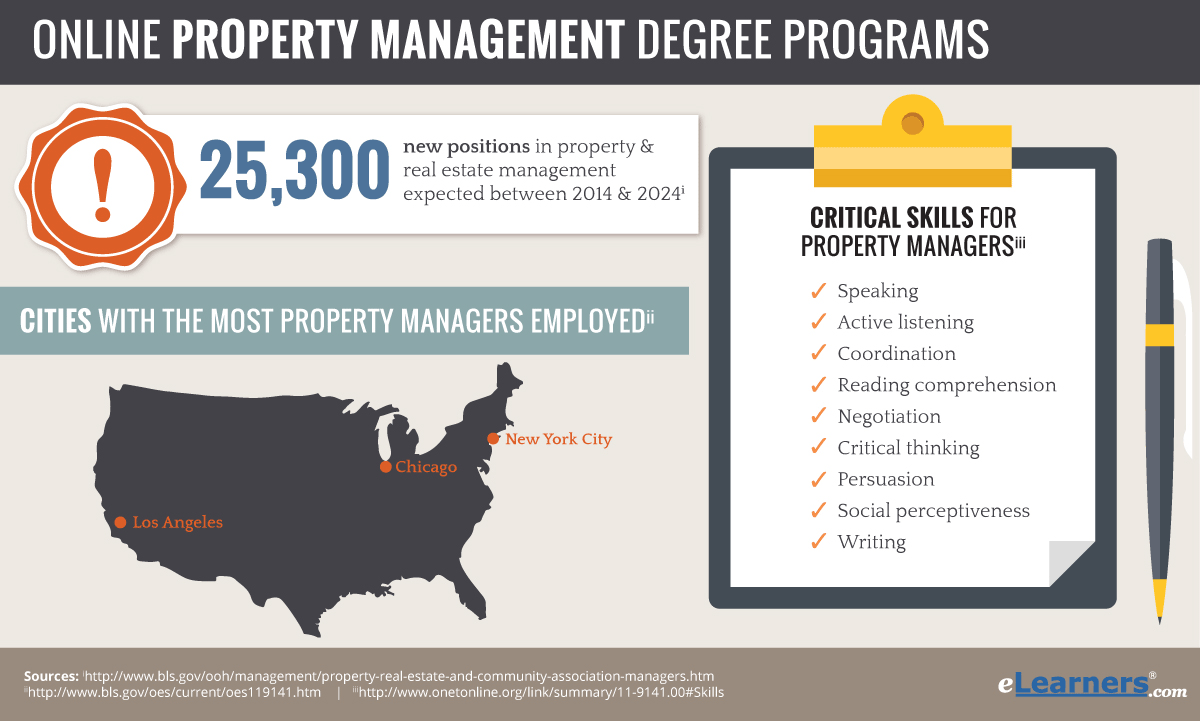
- Expected Job Growth, 2014 to 2024: 8%vii
Though a high school or GED equivalent diploma is the minimum requirement, many employers look to hire candidates with at least a bachelors degree, especially for offsite positions that deal with a property’s finances.
Real estate managers who buy and sell property must have a real estate license in their practicing state. In addition, some states require that community association and property managers also have a real estate license.
A few states require that property, real estate, and community association managers earn professional credentials or licensure. Many managers working outside of the states with required licenses obtain licenses in order to show competence and professionalism. Most states require recertification every two years. Many groups offer multiple designations, certifications, and professional development courses.
FIVE of these include:
- BOMI International
- Community Associations Institute
- Institute of Real Estate Management
- National Association of Residential Property Managers
- Community Association Managers International Certification Boardviii
Find the Perfect Online Real Estate Degree and Property Management Degree For You
Are you interested in learning how economic trends can affect the real estate market? Does the thought of selling real estate or managing properties interest you?
Then take the next step to earning your online real estate degree or online property management degree.
- Click on any of the sponsored listings on this page to learn more about individual programs, including specific courses and admissions requirements.
- Then, you can even contact your favorite schools directly to request more information.
- Apply today!
[i] bls.gov/ooh/sales/real-estate-brokers-and-sales-agents.htm#tab-2 [ii] bls.gov/ooh/management/property-real-estate-and-community-association-managers.htm#tab-4 [iii] bls.gov/ooh/sales/real-estate-brokers-and-sales-agents.htm#tab-5 [iv] bls.gov/ooh/sales/real-estate-brokers-and-sales-agents.htm#tab-6 [v] bls.gov/ooh/sales/real-estate-brokers-and-sales-agents.htm#tab-4 [vi] bls.gov/ooh/management/property-real-estate-and-community-association-managers.htm#tab-5 [vii] bls.gov/ooh/management/property-real-estate-and-community-association-managers.htm#tab-6 [viii] bls.gov/ooh/management/property-real-estate-and-community-association-managers.htm#tab-4