
 Carpenters work with contractors, development companies, independent laborers to help with the construction and renovation of buildings, structures and interior spaces.
The carpentry industry involves utilizing specialized skills for the purpose of construction, installation and repair of structures and fixtures made of wood, plywood, and wallboard, using carpenter's hand tools and power tools.
Carpenters' knowledge of materials, methods, and tools for construction, as well as their understanding of reading blueprints, practical engineering application, and following safety codes make them a key component to the construction industry.
1 What do carpenters do?
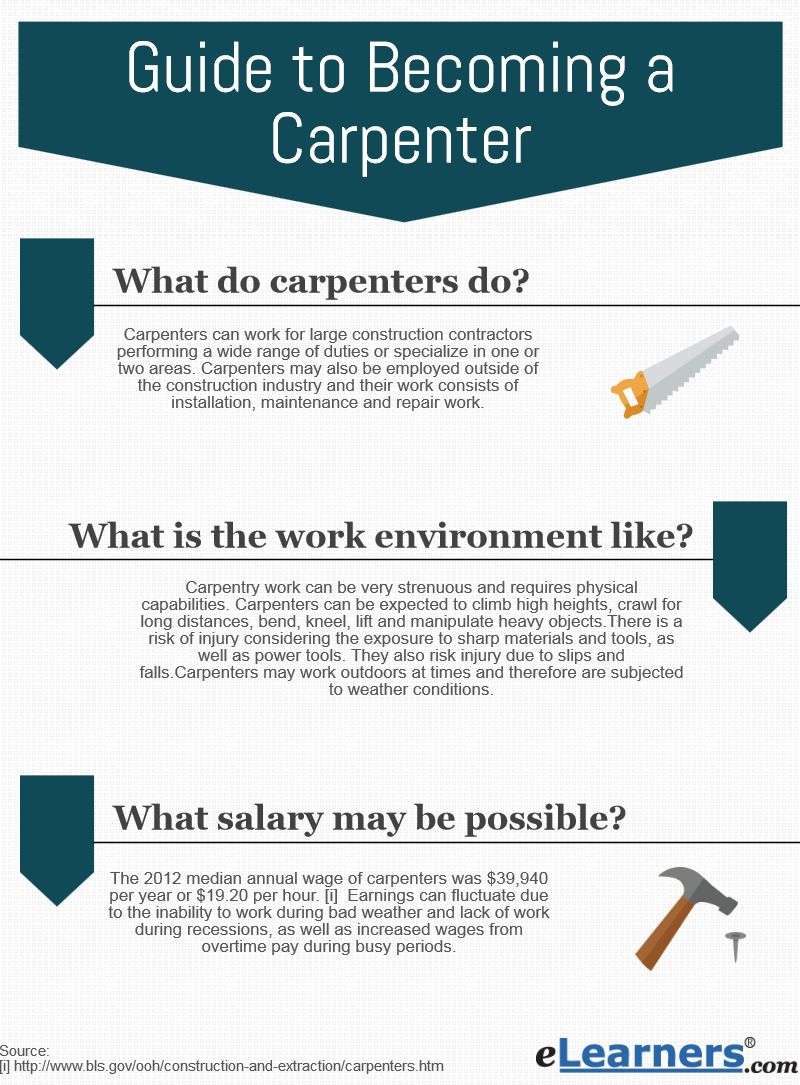
Carpenters can work for large construction contractors performing a wide range of duties or specialize in one or two areas. Carpenters may also be employed outside of the construction industry and their work consists of installation, maintenance and repair work.
Carpenters' training offers versatility which qualifies them to work in residential building, commercial construction and remodeling work, to suite their needs. Typical carpentry duties include:
- Framing walls and partitions
- Putting in doors and windows
- Building stairs
- Constructing wooden forms for pouring concrete
- Erecting scaffolding
- Building tunnel bracing
- Installing cabinets and molding
- Doing finishing work
- Laying hardwood floors
- Installing trim
Carpentry tasks vary to some degree, but many follow some basic steps. These steps include:
- Reading blueprints and designs
- Following the instructions of supervisors
- Performing layout work such as measuring and arranging materials
- Adhering to building safety codes
- Use hand and power tools to cut, shape, and join materials
- Check and survey the accuracy of their work and make adjustments when necessary
2 What are some common charasteristics of good carpenters?
Carpenters at all levels should have the following qualities:
- Good eye-hand coordination
- Ability to work alone and as part of a team
- Physical fitness
- Good sense of balance
- Manual dexterity
- Quick and accurate arithmetic-solving skills
- Ability to visualize all steps in an assigned task
In addition, carpenters wishing to advance to a supervisory position benefit from the following:
- Good communication skills to deal with clients and subcontractors
- The ability to formulate an accurate estimate and budget accordingly
- Proficiency in speaking Spanish as well as English due to the high percentage of Spanish-speaking construction workers
3 What is the work environment like for carpenters?
Carpentry work can be very strenuous and requires physical capabilities. Carpenters can be expected to climb high heights, crawl for long distances, bend, kneel, lift and manipulate heavy objects. There is a risk of injury considering the exposure to sharp materials and tools, as well as power tools. They also risk injury due to slips and falls. Carpenters may work outdoors at times and therefore are subjected to weather conditions.
Many carpenters work a standard 40-hour work week, but may need to work longer hours during busy periods. Since they typically work at project sites they may have commuting time to get to the job location. Due to the nature of project work, carpenters may work for a new contractor each time and therefore may have a variety of supervisors and co-workers.
4 What kind of educational background is needed to become a carpenter?
Union carpenters typically enter the trade as an apprentice and must spend three to four years of on-the-job training before becoming a journeyman. Carpenters learn their trade through formal and informal training programs. There are a number of ways to train, but a more formal training program often improves job opportunities.
Learning to be a carpenter can start in high school. Classes in English, algebra, geometry, physics, mechanical drawing, blueprint reading, and general shop will prepare students for the further training they will need.
After high school, there are a number of different ways to obtain the necessary training. Some people get a job as a carpenter's helper, assisting more experienced workers. At the same time, the helper might attend a trade or vocational school, or community college to receive further trade-related training and eventually become a carpenter.
For individuals searching for online programs in construction, there are many online construction degrees, the majority focusing on construction management. Accredited colleges and universities offer carpentry and construction training programs online and online courses in carpentry and construction.
On the job, apprentices learn elementary structural design and become familiar with common carpentry jobs, such as layout, form building, rough framing, and outside and inside finishing. They also learn to use the tools, machines, equipment, and materials of the trade. In the classroom, apprentices learn safety, first aid, blueprint reading, freehand sketching, basic mathematics, and various carpentry techniques. Both in the classroom and on the job, they learn the relationship between carpentry and the other building trades.
The number of apprenticeship programs is limited, however, so only a small proportion of carpenters learn their trade through these programs. Most apprenticeships are offered by commercial and industrial building contractors with union membership.
Some people who are interested in carpentry careers choose to get their classroom training before seeking a job. There are a number of public and private vocational-technical schools and training academies affiliated with unions and contractors that offer training to become a carpenter. Employers often look favorably upon these students and usually start them at a higher level than those without the training.
Carpenters who complete formal apprenticeship programs receive certification as a journeyman. Some carpenters earn other certifications in scaffold building, high torque bolting, or pump work. These certifications prove that carpenters are able to perform these tasks, which can lead to additional responsibilities.
5 What salary is typical for carpenters?
The 2012 median annual wage of carpenters was $39,940 per year or $19.20 per hour. [1] Earnings can fluctuate due to the inability to work during bad weather and lack of work during recessions, as well as increased wages from overtime pay during busy periods.
[1] http://www.bls.gov/ooh/construction-and-extraction/carpenters.htm
6 What is the outlook like for the carpentry industry?
The outlook for carpentry is good with an expected job growth about as fast as the average compared to all other occupations. This continuing need for carpenters is due to the increasing construction activity with building demands for new housing, offices, retail space, and the expansion of schools and industrial plants. In addition there will be a need to replace a steady stream of carpenters retiring from the industry.
Job opportunities should be best for those with the most training and skills. Those with a wide skill-set will have the best opportunities for steady work. Job opportunities for carpenters can also vary geographically due to the fluctuation of local economies. The areas with the largest population growth will provide the best opportunities for carpenters at all levels seeking employment.