
Sponsored Online Programs Available
Look Inside an Online Psychology Degree Program
Students looking into Online Psychology Degrees have a variety of choices, both in terms of concentrations, potential careers and types of academic programs. Psychology is defined as the study of behavior and mind. Professionals in this field are called psychologists, and classified as social, behavioral or cognitive scientists. If you are someone who is fascinated by concepts such as perception, emotion, motivation, patterns of behavior and brain functioning, studying Psychology may be a great fit.
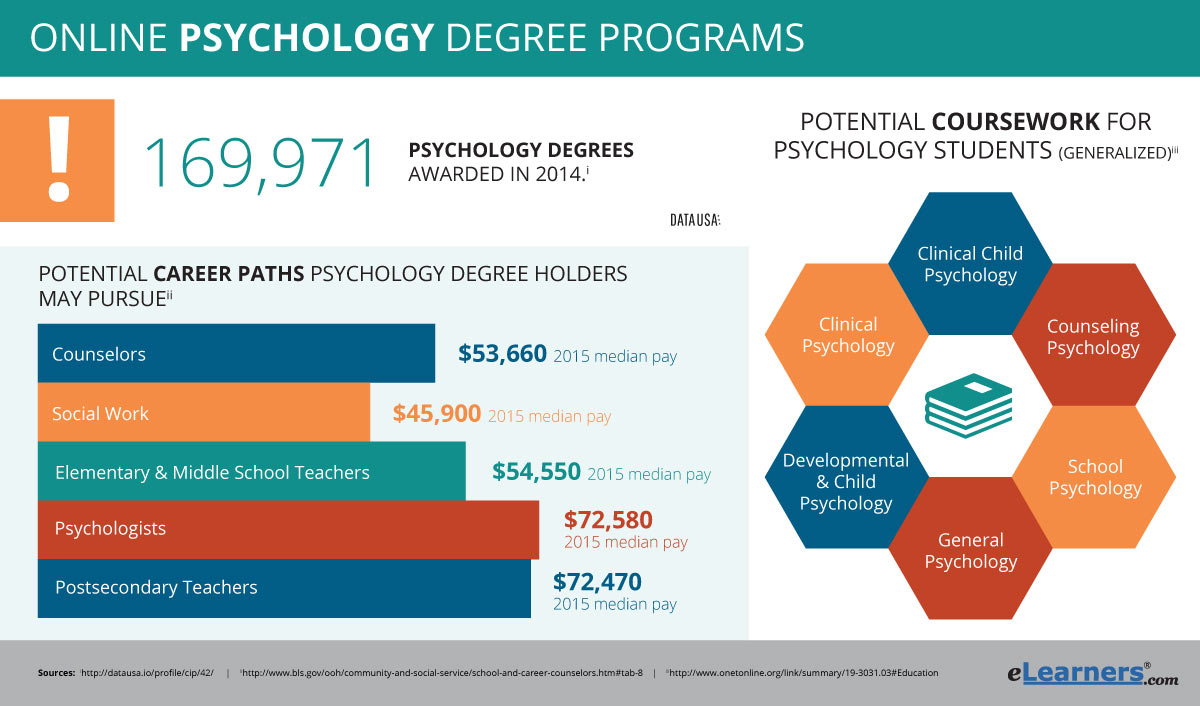
Psychology majors learn the necessary methods and theories to assist people in improving their mental health; they also gain knowledge and abilities that are valued in many other fields, such as business and politics. Earning your Psychology degree online may be the optimal way to deepen your knowledge, learn valuable skills, or prepare for a variety of potential career paths.
FUN FACT
The word psychology derives from Greek roots meaning the study of psyche or soul.[i]
Click To Tweet!
.png)
Online Psychology Degrees and Programs ~ The Essentials
Educational technology has advanced so that many schools have online Psychology Degrees and programs at both undergraduate and graduate levels. For students who have a busy schedule, find it impossible to attend class every day, study well independently or just live too far to commute, distance-learning may be attractive. Certainly, if you are currently working and want to boost your education with any kind of higher learning, online programs offer a flexible way to maintain your job while continuing your education.
DID YOU KNOW?
In 1890, William James defined& psychology;as "the science of mental life, both of its phenomena and their conditions."[ii]
Click To Tweet!
The great part about online psychology programs is the fact that you are not necessarily missing out on the standard psychology curriculum that is offered inside the classroom. Most online programs utilize nearly the exact same course work as campus based programs, although the courses are simply offered in a different format. And, as the virtual classroom brings life to your textbooks, the virtual libraries help you research and access online publications for review.
Do Psychologists Get Paid Well?
For an idea of how much money people earn in pschology-related jobs, see Psychologist Salary and Job Outlook.
How to Choose an Online Psychology Degree Program
Searching for an Online Psychology Program is really easy on the eLearners.com site. Choose a Degree Level depending on what your next academic step is. Requesting more information from each school is a good idea; compare tuition, requirements, curriculum and other vital components to your decision. While reviewing your options is straightforward, there are a few things you may want to consider when selecting an online psychology degree program. Read on for some helpful suggestions.
Is the Program 100% Online?
This being said, not all Online Psychology Programs may have the same structure. If a program in ‘asynchronous’, the courses are pre-recorded using audio and video that you are able to pause when you need to and usually, access 24/7. ‘Synchronous’ learning means that the classes are streaming live and you have to log in at a designated hour.
Online Doesn’t Mean All Alone
If you are someone who feels that discussions and class interaction are important to understanding coursework, these types of benefits may also be found in the online Psychology degree Programs. In your online classes, you may be required to post weekly or even daily to web-based discussion threads on topics provided by the professor. Sometimes, not only is your opinion and post required, but also responses to other student posts could be required. In other programs, you may be required to schedule online meetings with faculty at specific times. It is really wise to know what is involved, especially if you are working with a strict schedule or need to travel frequently.
Resources for eLearners
Doing your homework on the Online School or Psychology Degree you are considering is important. You want a program that matches your career goals, but also meets quality assurance. Resources such as online library assistance, tech support, tutoring, and career counseling should be available to you. A good online psychology program offers the services you need whether this be disability support services or a way to make an appointment with a guidance counselor, make sure your prospective program offers it by requesting those details in advance.
Accreditation and Online Psychology Degrees
Accreditation means that a program has met the quality standards obliged by an outside agency and have received a public certificate of accreditation. Choosing an accredited program may help you avoid disreputable institutions. Just as important, though, is that in most cases, those who would like to be licensed to practice psychology are required to have attended an accredited program. Many jobs have the same requirement.
There is a difference between institutional and program accreditation. Institutional accreditation is conferred upon a school in its entirety - not a single program – by one of six regional accreditation bodies. These organizations are recognized by the U.S. Department of Education.
In terms of individual Psychology Graduate programs, the most reputable and relied upon accrediting organizations are the American Psychological Association ("APA"), operating through its Commission on Accreditation, and the Association of State and Provincial Psychology Boards ("ASPPB").
Note that the “APA accredits doctoral graduate programs in clinical, counseling, school psychology and combination programs; internships, a required component of doctoral training; and postdoctoral residency programs in traditional and specialty practice areas of psychology”[iii]
Since the APA and ASPPB do not accredit non-doctoral programs, if you are choosing an associate, bachelor, master, or certificate online Psychology program be sure that the school has institutional accreditation. If the school has an APA or ASPPB accredited doctoral program for which the non-doctoral degree you seek is a component, this is an added assurance of quality, especially if the programs share faculty and resources. Otherwise, accreditation by one of the other agencies is also a sign of a quality program.
Online Psychology Degrees: Choose a Degree Level
Online Psychology Degrees are available in both undergraduate and graduate levels: Associates, Bachelors, Masters and Doctorate Degree programs. There are also many areas of concentration for you to consider. Bear in mind that each level of study may be rewarding, however, if you have a specific goal in mind, select an online degree in Psychology to support this decision. Think of it as building blocks!
For instance, according to the Bureau of Labor Statistics, in most states, practicing psychology or using the title of “psychologist” requires licensure. Although licensing laws vary by state and type of position, most clinical and counseling psychologists need a doctorate in psychology, an internship, at least 1 to 2 years of supervised professional experience. Passing the Examination for Professional Practice in Psychology is also required.[iv]
Online Associates Degree Programs in Psychology
An online Associate of Arts (AA) in Psychology is typically an introductory degree program. Admission commonly requires a high school diploma or the equivalent and involves about 2 years of full-time study or a minimum of 60 semester hours. Some individuals who have earned an associate degree in psychology may pursue advanced opportunities by earning a bachelor's degree in psychology, especially since most entry-level job options require a Bachelors degree at minimum. Some schools offer an integrated program that incorporates the associate degree program into a bachelor's degree program. Browse Associates
Online Bachelors in Psychology Degree Programs
According to the BLS, “most graduates with a bachelor’s degree in psychology find work in other fields such as business administration, sales, or education…or…may be able to find work in the field of psychology as assistants to psychologists.”[v] An online bachelor's degree in psychology is an undergraduate-level degree that typically takes 4 years to complete. At many universities, students may choose between a Bachelor of Arts (B.A.) and a Bachelor of Science (B.S.) Typically, B.A. degrees tend to require more liberal arts general education courses, while B.S. degrees require more science general education courses. Browse Bachelors.
Online Masters in Psychology Degree Programs
An online Masters degree in psychology is a graduate-level degree that may take between 2 and 3 years beyond the bachelor’s degree to complete. Similar to the bachelor’s degree, students might choose between a Master of Arts (M.A.) or a Master of Science (M.S.) in psychology, in all sorts of types of Psychology masters degrees. An MSc degree is likely to be more focused on research and the sciences, while an MA may be more focused on the arts and humanities aspects of psychology. You can even find psychology grad programs that don't require a GRE. Consider whether you are planning to pursue a doctorate program; some masters in psychology programs are considered terminal degree programs that prepare you to enter the workplace, while others are stepping-stones to a PhD or PsyD. Browse Masters.
Online Doctorate Degree Programs in Psychology
Doctoral degree programs in psychology teach students how to observe behavior, measure results and employ statistics to quantify outcomes. Earning this degree requires completion of a dissertation and possibly a comprehensive intern- or externship residency. Students might pursue either a Doctor of Psychology (Psy.D.) degree program (which is practice-oriented) or a Doctor of Philosophy (Ph.D.) degree program (which is research-based). Browse Doctorates .
Online Psychology Degrees: Common Concentrations
One of the potentially greatest benefits of an online psychology degree is the sheer versatility it provides. Psychology majors study different branches of psychology, theoretical perspectives, history, and research methods. With advanced education, students might find they are ready to focus their degree around one particular area in this vast field. Some of the common concentrations for study, and the molding of a career include[vi]:
- Clinical Psychology
- Health Psychology
- Neuropsychology
- Forensic Psychology
- Industrial-Organizational Psychology
- School Psychology
- Counseling Psychology
- Social Psychology
- Sports Psychology
- Counseling Psychology - Marriage and Family Therapy Graduate Programs
Take the Next Step
Whether you ultimately aspire to conduct research, consult with clients, work with a particular population or as part of a healthcare team, take the next step in your education. Browse listings for Online Psychology Degrees to find one that aligns with your academic and vocational goals today!
[i] en.wikipedia.org/wiki/Psychology | [ii] en.wikipedia.org/wiki/Psychology| [iii] apa.org/search.aspx?query=accreditation |[iv] bls.gov/ooh/life-physical-and-social-science/psychologists.htm | [v] bls.gov/ooh/life-physical-and-social-science/psychologists.htm |[vi] bls.gov/ooh/life-physical-and-social-science/psychologists.htm