
Sponsored Online Programs Available
Liberal Arts Online Degree Programs
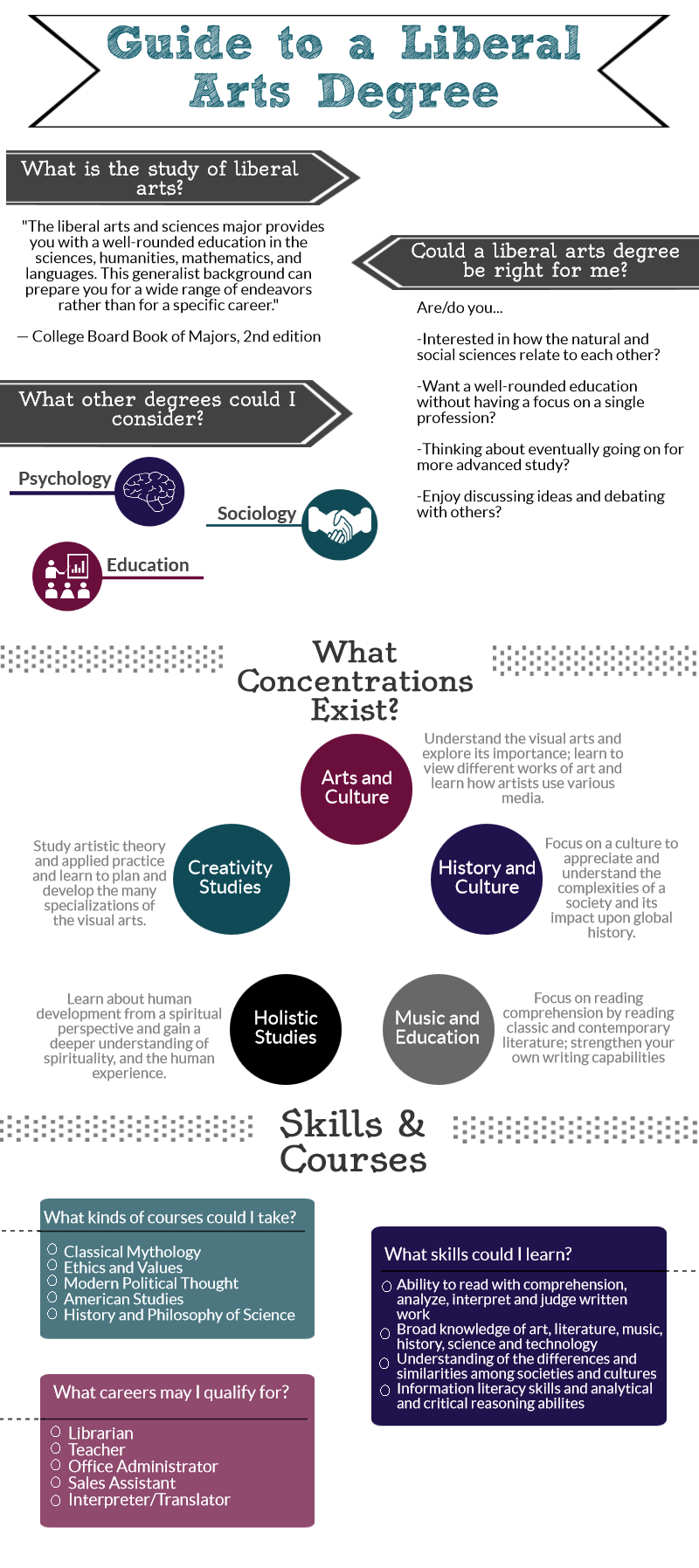
While there are many types of online liberal arts degree programs available, each with many differences, many of the majors or concentrations share similar overall goals and objectives.
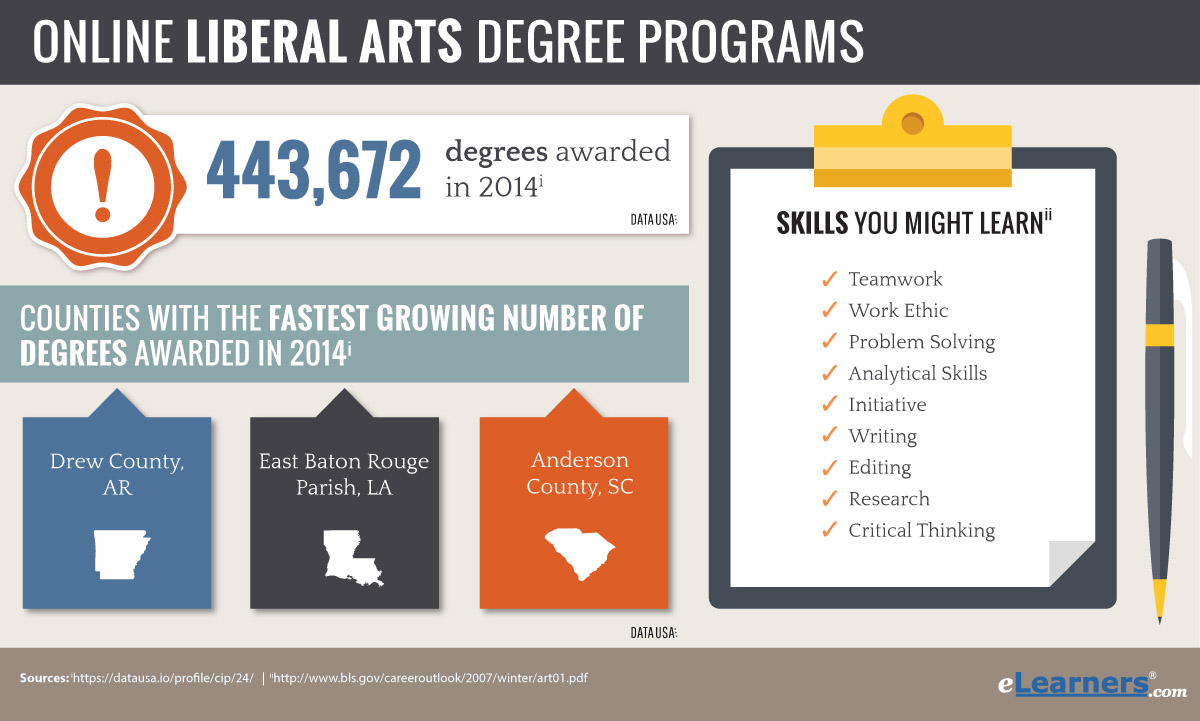
Though the specific topics may vary, typically these degrees are designed to develop the research, writing, and critical analysis skills of students. This is usually through a course of study focused on finding support for and defending arguments.
They were:
- Team flexibility
- Clear writing skills
- Problem-solving aptitude
- Strong oral communication
Online Liberal Arts Degree Schools
Below is a list of some of the schools that offer a variety of options for an online liberal arts degree. The list includes the degree levels that the school offers, as well as three examples of liberal arts majors or concentrations that are available at the school.
Did You Know?
A recent survey by the National Association of Colleges and Employers (NACE) of 180 companies revealed that four of the top five résumé traits that mattered most were hallmarks of liberal arts education.
Typically, each of the schools listed below offer a greater variety of online liberal arts degree programs than those listed. However, in order to find the perfect school for you, it’s important to confirm with each school to make sure they offer your desired major or concentration before applying.
Online Liberal Arts Degree Schools | ||
College | Degree Levels | Liberal Arts Degree Examples |
Bachelors, Certificate, Masters | English, Creative Writing, International Studies | |
Bachelors, Certificate, Masters | Journalism and Digital Media, Communication, Philosophy | |
Bachelors, Certificate, Masters, PhD | Communications, Applied Economics, Philosophy | |
Associates, Bachelors, Certificate, Masters | History, Communications, English | |
Bachelors, Certificate, Masters, PhD | Integrated Marketing, Economics, Interdisciplinary Studies | |
Associates, Bachelors, Certificate, Masters, PhD | History, Interdisciplinary Studies, Global Studies | |
Associates, Bachelors, Masters | ||
Associates, Bachelors, Certificate, Masters | Communication, Liberal Studies, Human Services | |
Bachelors, Certificate, Masters | Communication, Global Studies, Economics | |
Bachelors, Certificate, Masters, PhD | Women’s and Gender Studies, Applied Linguistics, Philosophy | |
What Is Liberal Arts?
Liberal arts is a variety of subjects designed to develop general intellectual capabilities as opposed to vocational or professional skills. This may help you acquire the tools necessary to navigate complex issues and strengthen your cultural and social analysis.
One of the benefits of earning an online liberal arts degree is the opportunity to hone valuable skills that may remain undeveloped while pursuing other majors. Some of these skill sets include:
- Critical thinking skills
- Communication abilities
- Creativity
Typically, this is through a wide range of courses, analyzing a number of different topics, performing in-depth research, and translating that research into effective communication, either through presentations or writing assignments.
Different Online Liberal Arts Degree Levels
When you decide to pursue a liberal arts degree you are provided many options. Typically, this starts by choosing one of the four degree levels or one of the available certificate programs. While each of these levels have the same overall goal of helping you develop skills to perform critical analysis of key topics, each have unique requirements for both admissions and graduation.
In addition, each of the levels offer students of an online liberal arts degree courses of varying difficulty. For instance, an associates level course may have the same name as a doctoral level course, however, usually the doctoral level course will require students to perform more in-depth analysis, research, and writing.
Below are the four different levels of an online liberal arts degree, as well as a description of the various certificate options. Each of the descriptions include any unique requirements and the how long it typically takes a full-time student to earn that liberal arts online degree.
LEVEL 1 - The Associates Degree in Liberal Arts
Most programs for online liberal arts associates degrees require students to complete 60 credits, which typically takes full-time students two years. However, there are some schools that require a different credit amount based on the unique design of that program.
Typically, this includes a number of general education courses that may fulfill some or all of the requirements for bachelors degree programs, which may make transferring easier. However, it’s important to check with a number of schools and to talk to your counselor about what specific courses may transfer and which may not.
Often, at the associates degree level, an online liberal arts degree is designed to provide students with an overall background and foundation for their continued education. Therefore, many programs don’t ask that you choose a major, though some do recommend that you choose a concentration to tailor your course of study in one particular field.
LEVEL 2 - The Bachelors Degree in Liberal Arts
If you decide to pursue an online liberal arts bachelors degree, typically programs require that you complete about 120 credits. Though there are some schools that have a unique design and require a different amount. Most full-time students can earn their degree in four years.
In addition, many bachelors degrees allow you the ability to transfer credits, either from an associates degree or from other schools, which may help reduce the time it takes to earn your degree.
Many bachelor degree programs ask that you choose a major in liberal arts, which may include any of those listed further down this page or from a number of other options that may not be listed. However, unlike other vocational or professional degrees, an online liberal arts degree typically offers you the ability to take more electives outside of your particular course of study.
Besides the curriculum designed for you to perform research and writing projects, the ability to take more electives is one of the reasons a liberal arts degree may help develop a variety of skills and expose you to a broad range of subjects.
LEVEL 3 - The Masters Degree in Liberal Arts
Usually, when you decide to pursue an online liberal arts masters degree, programs ask that you choose a major or concentration for your degree. While many programs are still designed for you to take a number of electives, choosing a concentration or major may help tailor your course of study to provide a more in-depth understanding of a particular field or subject.
Most masters degrees require that students earn roughly 36 credits, though the specific amount may vary from school to school. Typically, full-time students may earn their masters degree in two years, though many students also work full-time and attend school as part-time students. Usually it takes longer for these students to earn their masters.
ADDITIONAL REQUIREMENTS: In order to earn your masters degree, many schools ask that you complete a capstone or thesis project.
Normally, this integrates knowledge and skills developed in previous coursework and doesn’t include any new subject matter. Instead, these courses and requirements are designed to turn a student’s research proposal into a finished capstone project through a deeper analysis of topics already covered.
LEVEL 4 - The PhD in Liberal Arts
An online PhD in liberal arts is the highest degree you can earn in the field, otherwise known as the terminal, or "end" degree. Therefore, doctoral programs usually require more critical analysis, research, and writing than the other degree levels.
If you choose to pursue a PhD, it usually takes full-time students about five years to earn their PhD. However, there are some programs that are designed for students to earn their degree in as little as three years. Keep in mind that this is typically viewed as the shortest amount of time it should take to earn your PhD.
While the admissions vary from school to school, usually you need to have a masters degree from an accredited university, letters of recommendation, a resume, and a statement of purpose. Some schools may have stricter requirements, such as a minimum GPA while you earned your masters or a minimum score for your GRE.
ADDITIONAL REQUIREMENTS: The majority of PhD programs are designed so that upon completing all required courses, you are required to propose, write, present, and defend a dissertation to a board of faculty. Some programs also require that you complete a comprehensive exam.
LEVEL C - Liberal Arts Certificate Programs
Typically, there are three types of online liberal arts certificate programs, which are:
- Undergraduate Certificate: usually requires only a high school or GED diploma equivalent
- Graduate Certificate: requires that students have earned a bachelors degree from an accredited university
- Post Masters Certificate: requires that students have earned a masters degree from an accredited university
Keep in mind that there may be additional admissions requirements for certificates. These may include GRE or GMAT scores, a number of years of professional experience, and letters of recommendation. This is especially true for graduate and post-masters certificates, but may also apply to undergraduate options.
Most certificates require that students complete four to eight courses, though every program has a unique design. Certificates are usually designed with at least one foundational course in order to make sure that all students have a basic understanding upon which additional courses analyze in greater depth.
For the most part, certificates are designed as part-time programs. This may allow students with full-time jobs and other responsibilities to pursue a certificate. In this format, many students earn their certificate in one year, though some programs may take longer.
Different Types of Liberal Arts Degree Programs
An online liberal arts degree has many majors and concentrations for you to choose from. And even though it's online, there may be different formats—for example a program may offer self-paced online courses so that you can study on your down time. These can include any of the specific majors inside of the overall umbrella of liberal arts that are listed below. Or, some schools even allow you to choose your own course of study based on your interests and goals. Typically, that type of design is more for undergraduate students, but may be offered at the graduate level.
More often, programs ask students to choose a major just like any other degree program. What sets an online liberal arts degree apart from other programs is that liberal arts is typically designed to teach an interdisciplinary approach.
Therefore, students usually take more electives as opposed to more vocational degrees. This may help students:
- Understand a diversity of perspectives and fields of knowledge
- Demonstrate critical thinking and communication skills that relate to civic engagement or community issues
- Employ primary and secondary resources to perform effective research
Listed below are some of the majors you may choose from if you decide to pursue an online liberal arts degree. Included in the description are specific concentrations that may be offered or variations of that specific degree.
History Degrees
Online history degrees explore multiple regions and cultures through a broad curriculum. Typically, this is through an analysis of various historical sources, interpreting events and human communities in their historical context, and evaluating historical events and trends from a global perspective.
Some of the common courses you may take while pursuing a history degree include:
- History of Western Civilization
- Historical Methodology
- Historiography
- Comparative History and Research
Many schools that offer an online history degree also offer a number of concentrations or variations of your history major. Some of these are listed below.
Public History
Public history takes the elements of history degrees and combines it with the preservation and interpretation of historical records and artifacts. Typically, coursework uses a combination of research, critical analysis, and writing to analyze and explain past human behavior in a variety of contexts.
Some of the public history courses may include:
- Public History Media
- Management of Historical Records
- Public History Strategic Management
Military History
An online military history degree analyzes the military as an institution within chronological and geographical contexts. This may include analyzing the military as both a fighting and peacekeeping force.
Typically, your curriculum combines a number of courses in history, political science, and military history to teach a complete understanding of how the military and civilian authority should coexist. Some of the other key topics include examining the:
- Relationship between grand strategy and war
- Moral and ethical concerns
- Character traits of moral and effective leaders
Communications and Public Relations Programs
As the way we communicate continues to adapt and to use new technology, an online communications and public relations degree integrates digital technology with innovative communication and strong writing skills. Typically, this is through courses designed to teach conceptual knowledge and practical skills to manage communication issues in the modern workplace.
Some of the key topics of a communications and public relations degree include:
- Business and professional communication
- Leadership, persuasion, and social influence
- Conflict and negotiation
- Intercultural communication in the global marketplace
Some of the common courses you may take while pursuing a communications degree include:
- Introduction to Human Connection
- Gender and Communication
- Organizational Communications
- Communication in the Digital Age
Some of the communications or majors included under communications and public relations are listed below.
Strategic Public Relations
Strategic public relations is focused on developing and delivering effective content. Typically, this includes examining key topics of the field, such as:
- Generating impactful, relatable messages
- Selecting the best communication channels for proper message distribution
- Evaluating communication efforts against established goals and benchmarks
Usually, programs combine a variety of courses in subjects such as statistics, psychology, and other disciplines to build a foundation for effective communication in any field. Some of the specific courses you may take include:
- Electronic Public Relations
- Writing Public Relations
- Strategic Communications in a Global Environment
- Principles of Strategic Communication
Journalism and Mass Communication
Technology has changed the way we absorb our news. As a result, online journalism and mass communication degrees have adapted to teach how to produce content to reach this new audience.
By analyzing each of the aspects of the various digital platforms, such as website content, social media, and the analytics to track the success of various content, mass communication has morphed to reach an online audience. Some of the courses you may take include:
- Introduction to Mass Communication
- Graphics and Layout in Digital Media
- History of Mass Communication
- Political Communication
English Degrees
Online English degrees look to develop strong critical thinkers who can articulate difficult concepts in clear language. Usually, this is through an analysis of literary texts within the frames of literary history and theory.
As a result, these programs are designed to teach students a complete understanding of the English language, strengthen your comprehension of our world, and your ability to communicate.
Some of the courses you may take while pursing an English degree include:
- American Literature
- International Voices
- Critical Reading and Writing About Literature
- Topics in Contemporary Literature
English Language and Literature
While similar to an English degree, and English language and literature degree is focused on developing research and critical thinking skills. Typically, this is through pinpointing and analyzing information that proves support for your ideas and opinions.
Many English language and literature programs are also tied into online creative writing programs. This may provide a curriculum that teaches how to craft stories through an analysis of some of the classic English literature.
Some of the courses you may take include:
- Literary Theory
- Shakespeare
- Literature and Critical Thinking
- Literature Studies
Languages Degree Programs
Online language degrees are focused on teaching you the elements of specific languages. However, many programs have curriculum designed to teach more than just grammar and vocabulary, such as the culture, history, and variations of the language.
Typically, courses use historical texts, mass media, and current social debates to teach the language through practical application. Some of the goals of languages degree programs are that students:
- Be able to read, write, and comprehend another language at an advanced level
- Demonstrate ability to read literary text and analyze it in another language
- Communicate verbally at an intermediate level
Some of the variations of an online languages degree or concentrations available for the major are listed below.
Applied Linguistics
An online applied linguistics degree is designed to teach students the empirical, theoretical, and practical dimensions of the field. Usually, this is through an interdisciplinary curriculum focused on teaching key topics, such as:
- Basic theoretical linguistics
- Ethnographic research methods
- ESL/ EFL methodologies
- Cross cultural studies
Many courses are designed to teach the impact that diversity may have on the understanding of various languages. As a result, many programs emphasize the culture and history of various languages to provide a context and foundation for students to have a widened perspective.
Translation
As the modern world continues to shrink—or at least to become more interconnected—there are more interactions between businesses, organizations, and people of various cultures. As a result, online translation degree programs strive to teach students who are interested in meeting the challenges of modern multilingual, multicultural societies.
Four of the key topics you may study in translation include:
- Exploring the history, principles, theory, and practice of oral and written translation
- Practicing the techniques of legal, medical, technical, general, and literary translation
- Using specialized dictionaries and other essential reference materials
- Improving knowledge of various syntaxes, morphologies, and semantic systems
Other Subjects for Your Liberal Arts Degree
Besides the online liberal arts degree options listed above, there are still a number of other majors or concentrations you may be able to choose for your liberal arts degree.
Some of the other options for you online liberal arts degree include:
- Online Women’s Studies Degree
- Online Philosophy Degree
- Online Humanities Degree
- Online Economics Degree
- Online Liberal Studies Degree
- Online Interdisciplinary Studies Degree
- Online Area, Ethnic, and Cultural Studies Degree
Keep in mind that not every school will offer each of these options or all of the options described above. Therefore, it’s important to check with a number of different schools before applying in order to find the perfect school for you.
What Jobs Can You Do With a Liberal Studies Degree?
Upon earning an online liberal arts degree, many students fear that they will not be able to find a career to pursue. However, many employers prefer students who have earned a liberal arts degree because of the critical analysis, research, and communication skills those programs strive to develop in students.
Some of the careers you may pursue upon earning an online liberal arts degree include:
Public Relations Specialist:
- 2020 Median Annual Salary: $62,810i
- Projected Job Growth, 2019 – 2029: 7%ii
Technical Writers:
- 2020 Median Annual Salary: $74,650iii
- Projected Job Growth, 2019 – 2029: 10%iv
Interpreters and Translators:
- 2020 Median Annual Salary: $52,230v
- Projected Job Growth, 2019 – 2029: 20%vi
Advertising, Promotions, and Marketing Managers:
- 2020 Median Annual Salary: $141,490vii
- Projected Job Growth, 2019 – 2029: 6%viii
Public Relations and Fundraising Managers:
- 2020 Median Annual Salary: $118,430ix
- Projected Job Growth, 2019 – 2029: 9%x
Postsecondary Teachers:
- 2020 Median Annual Salary: $80,790xi
- Projected Job Growth, 2014 – 2024: 9%xii
Candidates for many of the positions listed above are required to have a bachelors degree.xiii However, some have unique criteria. For instance, interpreters and translators need to be fluent in at least two languages.xiv
On the other hand, while a bachelors degree is required to become a public relations or fundraising manager, many employers seek candidates who have earned a masters degree.xv In addition, in order to become a postsecondary teacher, candidates are almost always required to have earned a PhD in the specific field.xvi
How to Get Your Online Liberal Arts Degree
Are you interested in earning an online liberal arts degree? Take the next step to finding the perfect program for you.
Click on any of the sponsored listings on this page to read program descriptions and check out available majors and concentrations. You can even request more information directly from your favorite schools and learn how to apply today.
[i] bls.gov/ooh/media-and-communication/public-relations-specialists.htm#tab-1 [ii] bls.gov/ooh/media-and-communication/public-relations-specialists.htm#tab-1 [iii] bls.gov/ooh/media-and-communication/technical-writers.htm#tab-1 [iv] bls.gov/ooh/media-and-communication/technical-writers.htm#tab-1 [v] bls.gov/ooh/media-and-communication/interpreters-and-translators.htm#tab-1 [vi] bls.gov/ooh/media-and-communication/interpreters-and-translators.htm#tab-1 [vii] bls.gov/ooh/management/advertising-promotions-and-marketing-managers.htm#tab-1 [viii] bls.gov/ooh/management/advertising-promotions-and-marketing-managers.htm#tab-1 [ix] bls.gov/ooh/management/public-relations-managers.htm#tab-1 [x] bls.gov/ooh/management/public-relations-managers.htm#tab-1 [xi] bls.gov/ooh/education-training-and-library/postsecondary-teachers.htm#tab-1 [xii] bls.gov/ooh/education-training-and-library/postsecondary-teachers.htm#tab-1 [xiii] bls.gov/ooh/media-and-communication/technical-writers.htm#tab-1 [xiv] bls.gov/ooh/media-and-communication/interpreters-and-translators.htm#tab-1 [xv] bls.gov/ooh/management/public-relations-managers.htm#tab-1 [xvi] bls.gov/ooh/education-training-and-library/postsecondary-teachers.htm#tab-1