
Sponsored Online Programs Available

Online Degrees in the Medical Field
While earning an online medical degree, programs teach current research and techniques used in the health care industry in order to more efficiently treat patients and their illnesses. This may include a number of different fields, such as disease prevention, medicine, health and wellness, biotechnology, and others in the medical field.
Did You Know?
90% of respondents from 18 to 24 years of age said they would trust medical information shared by others on their social media networks.
Different Online Medical Degree Options
If you decide to pursue an online medical degree, there are a number of options that may be available to you. There are many aspects covered in the field of medicine and health, which encompasses all of the different aspects of serving patients, as well as all of the processes involved.
Each of the different degree options and types of medical degrees listed below analyze one aspect of treating patients. Some health and medicine degrees also focus on the business and financial aspects of health care.
The descriptions below also include some of the common courses you may take while pursuing that particular degree. However, keep in mind that every program has a unique makeup, and that specific courses, and their titles, may vary from school to medical school.
Online Osteopathy Degree
Osteopathic medicine is a medical approach that looks at the whole body, and all of the organs and tissues, as one complete unit as opposed to separate parts that may become injured or diseased.
Usually, while pursuing an online osteopathy degree, courses include using your hands as a physician in order to treat and diagnose patients. As a result, while studying osteopathy, programs teach a holistic approach that includes integrating the patient as a partner in the health care process.
Typically, online osteopathy degrees are offered only at the doctorate level. Often, programs include intensive courses and clinical reviews focused on developing your skills for real-world applications.
4 Common Courses While Earning an Online Osteopathy Degree
- Medical Biochemistry
- Medical Physiology
- Principles of Clinical Medicine
- Osteopathic Clinical Skills
What’s the Difference Between a DO and MD Degree?
Both MD (Doctor of Medicine) and DO (Doctor of Osteopathic Medicine) are doctors licensed to practice in the United States. However, there are differences in their training and philosophy of patient care.
For instance, an allopathic or MD degree, which is the more common of the two degrees, is usually focused on treating diseases and illnesses, as well as the rehabilitation from injuries.
The format of many MD degrees usually includes:
- Two Years of Basic Sciences
- Two Years of Clinical Clerkships
On the other hand, an osteopathic degree (DO) is more focused on therapeutic healing and allowing the body to heal itself. This may include overlapping subjects and concepts of allopathic students. However, it is more focused on preventative measures and the physical manipulation of the body.
Online Health Administration Degree
Online health administration degrees teach how health care as it relates to business, technology, quality management, ethics, and policy. Often, this includes concepts and theories, as well as the practical application of improving the effectiveness and efficiency of treating patients.
5 Common Health Administration Courses
- Healthcare Strategic Management and Policy
- Healthcare Research and Evaluation Methodologies
- Principles of Epidemiology
- Economics and Decision Making in Healthcare
- Human Capital Management in Healthcare
Online Health Science Degrees
Online health science degrees include a wide variety of subjects that combine the use of science and technology to find better ways to treat diseases in human and animal patients.
One of the most popular subjects under the umbrella of health science is health informatics. This field integrates information science, computer science, social science, health care, and data analytics in order to help organizations improve the overall quality of health care and the health of entire populations.
4 Common Courses in Health Science
- Complementary Health Care
- Fundamentals of Wellness
- Health Care Information Systems Analysis and Design
- Cornerstones of Health Informatics for Organizational Operations
Online Biotechnology Degrees
Biotechnology is the development of technologies and products that help improve our lives by harnessing the cellular and biomolecular processes. While earning an online biotechnology degree, one of the key subjects students may examine the fundamental principles of genetic engineering.
By studying the principles and concepts of the field, programs teach how to apply this knowledge to answer some of humanity’s problems, beyond only health care. Some of the applications of biotechnology include:
- Curing Diseases
- Reducing Environmental Footprints
- Feeding the Hungry
- Developing Cleaner Energy
4 Common Biotechnology Courses
- Foundations in Bioscience
- Molecular Biology
- Advanced Biosecurity and Bioterrorism
- Societal Issues in Biotechnology
Online Exercise Science Degree
Online exercise science degrees are usually offered as a concentration under kinesiology degrees. While kinesiology consists of all of the approaches to the study of human movement, as well as public and personal health, exercise science is the study of physiological and functional adaptations to movement.
Typically, exercise science programs teach a proficiency in topics such as:
- Functional anatomy
- Exercise physiology and kinesiology
- Exercise program design
4 Common Courses in Exercise Science
- Functional Anatomy
- Advanced Exercise Prescription
- Motor Development, Control, and Motor Learning
- Applied Nutrition
Other Online Medical Degree Options
Besides those already listed, there are still many other options available for students who want to earn an online medical degree, including doctoral degrees. Some of these include majors in:
- Clinical Research
- Biomedicine
- Molecular Medicine
- Physical Therapy
- Public Health
- Nursing
It is nearly impossible to provide a complete list of all of the different degrees offered in health and medicine. As a result, there may be other options available to you besides those listed here. Check with a number of different schools and consider your own goals and current academic standing to find the perfect program for you.
Different Online Medical Degree Levels
While some of the degrees mentioned above are only offered at one level or another, such as the osteopathy degree only available as a doctorate, many of the degrees are offered at four different levels. Many online medical degrees may also be offered as certificates, which are short, non-degree medical programs.
These different online medical degree levels are:
- Online Associates Degree in Health and Medicine
- Online Medical Bachelor Degrees
- Online Certificate in Medicine
- Online Medical Masters Degree
- Online Doctorate of Medicine
Most of the degrees require that you have earned the degree level before, such as a masters degree before a doctorate. However, that is not the case with bachelors degrees, which typically require a high school or GED equivalent diploma and not an associates.
In addition, some certificates are considered undergraduate and have similar admissions requirements as bachelors degree programs. Others are graduate certificates that require that you have earned a bachelors degree.
Therefore, when choosing which degree level is perfect for you, consider your current education level and the prerequisites and other admissions requirements. Also, check with a number of schools to find a program that matches your goals.
Can You Get a Medical Degree Online?
There are many medical degrees available that you can earn online. Some degrees, especially graduate programs, though some bachelors and certificates, may require that students go on campus for some clinical work or clerkship requirements. By contrast some schools may emphasize online learning with options like self-paced online classes you can take in your free time. However, this may depend on the specific degree and the makeup of the program.
As a result, it is important to consider your own goals and to check the specific requirements of each school to find a perfect match for you.
What Is It Like to Study Medicine?
The majority of medical schools organize the curriculum into two parts. The first two years include basic science training in fields such as:
- Medical concepts
- Structure and function of the body
- Diseases
- Diagnosis
The second two years involve clinical clerkships, which typically includes:
- Basic instruction
- Hands-on experience with patients
Both of these parts are designed to prepare you for your residency, which typically lasts three to eight years upon earning your medical degree. The residencies are usually in one area of expertise.
Normally, in the third year of medical school, students perform rotations in a number of specialties. By the end of the third year, most students have chosen the specialty for their residency.
Medical degrees are also designed to prepare you to become licensed, which typically begins during the second year with the United States Medical Licensing Examination (USMLE) Step 1. The rest of the exam schedule, and the topics they cover, are:
- Step 1 Exam: 2nd Year of Medical School: Practice of Medicine
- Step 2 Exam: 3rd or 4th Year of Medical School: Measures Clinical Knowledge and Skills
- Step 3 Exam: 1st or 2nd Year of Residency: Summation of Topics While Earning MD
What Is Pre Medicine?
Pre medicine, or pre med as it more commonly referred to, are students who have the goal of attending medical school upon earning their undergraduate degree. While there are no specific “pre med” majors, there are typically specially designed programs at many schools that may help to make sure that you take all of the requisite courses.
As a result of the many course requirements, many students choose to major in a science while earning their bachelors degree. However, this is not mandatory. In fact, often your specific undergraduate major doesn’t matter as long as you meet specific course requirements.
Online Pre Med Majors
Historically, pre med students chose to earn an undergraduate degree in science, such as biology or chemistry, in order to satisfy all of the course requirements for medical school.
The course requirements are heavy in the sciences and may include:
- Biology
- Physics
- Chemistry (Organic and General)
However, the majority of medical schools do not have any specific undergraduate major requirements. In fact, some prefer that students have undergraduate majors outside of the sciences in order to show a more well rounded education. Keep in mind though, that every school has unique admissions requirements.
According to the Association of American Medical Colleges (AAMC), the five most popular undergraduate majors for students who enrolled in medical school for the 2016-2017 academic year are:
- Biological Sciences
- Other (Majors that aren’t biological, physical, social, or health sciences, math and statistics, or the humanities)
- Social Sciences
- Physical Sciences
- Humanities
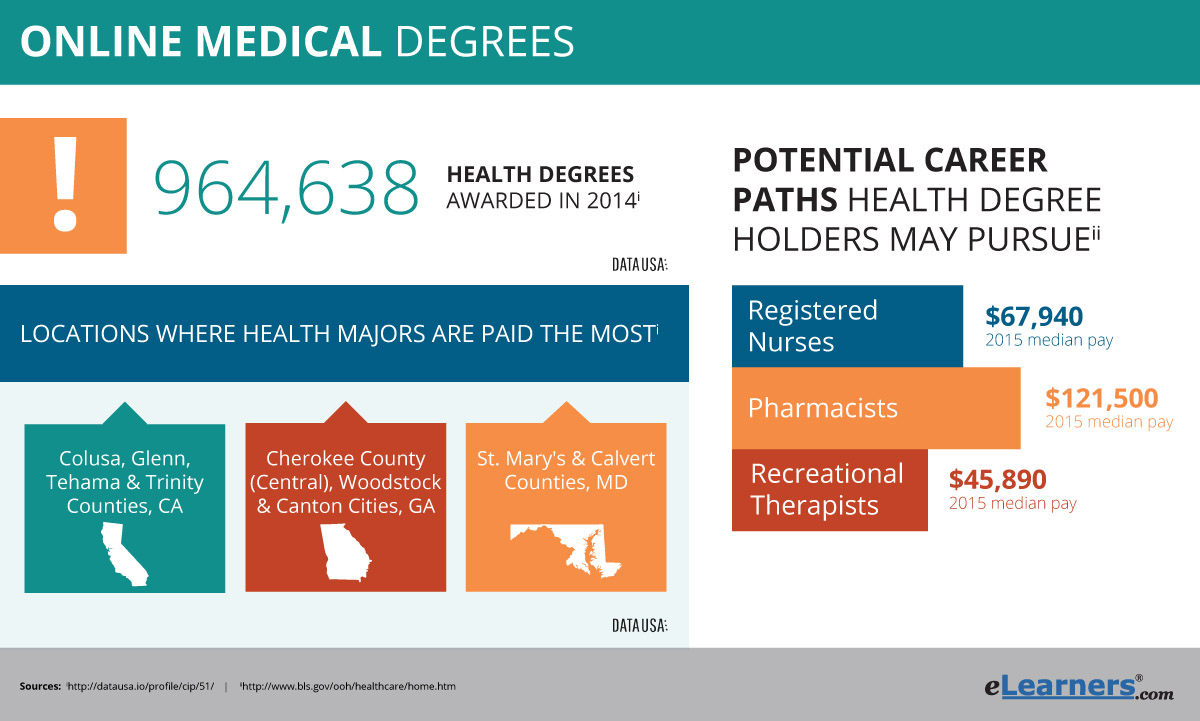
Possible Careers in Medicine
There are as many career options in the health and medicine as there are degree options. These typically include a wide variety of fields inside the health care field, such as health care management, health science, or clinical research.
Therefore, upon earning your online medical degree, some of the careers you may pursue, and their 2020 median annual salary, include:
- Pharmacists: $128,710i
- Physician Assistants: $115,390ii
- Physical Therapists: $91,010iii
- Nuclear Medicine Technologists: $79,590iv
- Medical and Health Services Managers: $102,280v
The specific responsibilities and requirements for each of these positions may vary. However, typically, in order to become a pharmacist or physical therapist, you need to earn a doctorate degree. Normally, a masters degree is required to become a physician assistant.vi
Most medical and health services managers have a bachelors degree, though masters degrees are becoming more common.vii Normally, you only need an associates degree in order to become a nuclear medicine technologist.viii
What Do You Learn in Medical School?
Medicine has two basic meanings.
They are:
- The practice of the diagnosis, treatment, and prevention of disease
- The medications, drugs, and substances used to cure diseases
As a result, many online medical degree programs teach a combination of the two. This may include analyzing the key concepts of both topics under one degree or concentration. It may also include analyzing one of these aspects more in depth under one degree.
This is why the majority of medical schools combine research and application. However, even undergraduate programs, such as an associates degree in medical assisting, focuses on the prevention of disease and how to diagnose it. Therefore, all health and medical degrees focus on these two aspects in some way, shape, or form.
Find the Perfect Online Medical Degree For You
Are you interested in learning more about a specific online medical degree? Then click on some of the sponsored listings on this page to take the next step.
Each of these schools and programs have all the information you may need to find the perfect school for you, such as program descriptions, curriculum, and admissions requirements. You can even contact the schools directly to request more information and apply today.
[i] bls.gov/ooh/healthcare/pharmacists.htm#tab-1 [ii] bls.gov/ooh/healthcare/physician-assistants.htm#tab-1 [iii] bls.gov/ooh/healthcare/physical-therapists.htm#tab-1 [iv] bls.gov/ooh/healthcare/nuclear-medicine-technologists.htm#tab-1 [v] bls.gov/ooh/management/medical-and-health-services-managers.htm#tab-1 [vi] bls.gov/ooh/healthcare/home.htm [vii] bls.gov/ooh/management/medical-and-health-services-managers.htm#tab-4 [viii] bls.gov/ooh/healthcare/nuclear-medicine-technologists.htm#tab-4